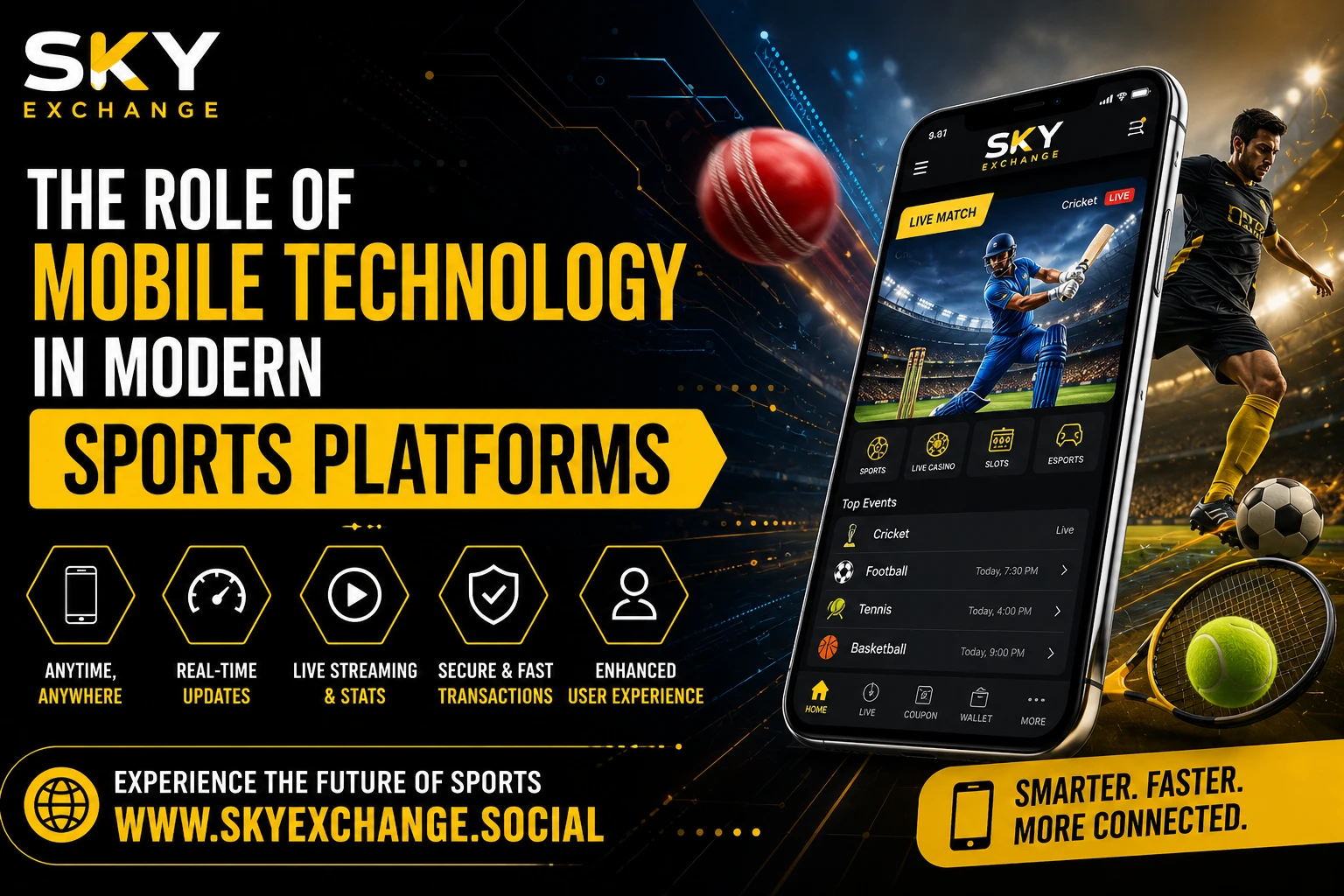
The role of mobile technology in modern sports platforms has fundamentally reshaped how people engage with sports, entertainment, and betting over the past decade. What once required a desktop computer and a stable internet connection can now be accomplished from a smartphone in a matter of seconds, anywhere and at any time. This shift has not merely been a matter of convenience—it has redefined user expectations, forced platforms to rethink their entire architecture, and created an ecosystem where mobile-first design is no longer optional but essential. Understanding the role of mobile technology in modern sports platforms is essential for anyone trying to make sense of how the betting industry operates today, since almost every meaningful innovation in this space over the last several years traces back to smartphone adoption. Nowhere is this transformation more evident than in the world of online sports betting, where platforms like Sky Exchange have positioned mobile technology at the very center of their strategy.
The Role of Mobile Technology in the Shift from Desktop to Mobile-First Betting
There was a time when online betting was almost exclusively a desktop activity. Users would sit down at their computers, log into their accounts, browse through odds, and place their bets in a deliberate, unhurried manner. That era has largely passed. Today, the majority of betting activity happens on smartphones, often in short bursts throughout the day—during a commute, a lunch break, or while watching a live match unfold on television.
This behavioral shift has forced platforms to reconsider every aspect of their design philosophy. Interfaces that once made sense on a large monitor with a mouse and keyboard had to be reimagined for smaller screens navigated by thumbs. Load times that were acceptable on broadband connections became liabilities on variable mobile networks. The entire user journey, from registration to deposit to bet placement to withdrawal, needed to be compressed and optimized without sacrificing functionality or security. This is exactly where the role of mobile technology in modern sports platforms becomes most visible: it dictates the pace at which an entire industry redesigns itself.
Platforms that recognized this shift early gained a substantial competitive advantage. Rather than treating mobile as an afterthought or a scaled-down version of the desktop experience, forward-thinking operators began building mobile-native experiences designed from the ground up for touch interaction, smaller viewports, and on-the-go usage patterns. This is precisely the philosophy that has guided the development of the Sky Exchange app, which delivers full platform functionality optimized specifically for mobile devices rather than a compromised subset of desktop features.
The Role of Mobile Technology in Speed and Performance
In the world of live sports betting, seconds matter enormously. Odds shift rapidly during live events, and a delay of even a few seconds between deciding to place a bet and the transaction actually completing can mean the difference between securing favorable odds and missing the opportunity entirely. This reality has made speed and performance one of the most critical battlegrounds for mobile betting platforms, and it’s here that the role of mobile technology in modern sports platforms is felt most directly by everyday users.
Modern mobile apps must be engineered to load instantly, process transactions in near real-time, and update odds dynamically without requiring manual refreshes. This requires sophisticated backend infrastructure capable of handling massive concurrent user loads, particularly during major sporting events when millions of users might be active simultaneously. The technical challenge extends beyond just server capacity—it involves efficient data compression, smart caching strategies, and network optimization techniques that ensure smooth performance even for users on slower mobile connections or in areas with inconsistent network coverage.
The mobile experience offered through platforms like SkyExchange reflects this emphasis on performance. Every element of the app, from the initial loading screen to the live betting interface, has been engineered with speed as a foundational priority. This isn’t merely about user satisfaction, though that matters considerably—it’s about ensuring that the fundamental promise of live, in-play betting can actually be delivered reliably.
The Role of Mobile Technology in Security and Trust
As betting activity has migrated to mobile devices, security concerns have evolved correspondingly. Mobile devices present unique security challenges that desktop computers don’t face in the same way. They’re more easily lost or stolen, often connect to public and unsecured Wi-Fi networks, and are frequently used in public spaces where shoulder-surfing or observation becomes a genuine risk.
Recognizing these challenges, modern betting platforms have integrated sophisticated security measures directly into their mobile applications. Biometric authentication, including fingerprint scanning and facial recognition, has become standard on supported devices, allowing users to access their accounts securely without needing to type passwords in public settings where they might be observed. This technology strikes an important balance between convenience and security, providing fast access while maintaining robust protection against unauthorized entry.
The SkyExchange login and SkyExch systems exemplify this approach to mobile security. Beyond biometric options, the platform incorporates encrypted data transmission, session timeout features that automatically log out inactive accounts, and monitoring systems designed to detect unusual login patterns that might indicate compromised credentials. These layered security measures illustrate the role of mobile technology in modern sports platforms as not just a convenience layer but a genuine trust infrastructure.
Two-factor authentication has also become increasingly prevalent, adding an additional verification step for particularly sensitive actions like large withdrawals or changes to account security settings. While this adds a small amount of friction to certain processes, users have increasingly come to appreciate these measures as reasonable trade-offs for the peace of mind they provide, particularly given the financial stakes involved in betting activities.
The Role of Mobile Technology in Real-Time Engagement
One of the most significant advantages mobile technology offers over traditional desktop platforms is the ability to maintain real-time engagement with users even when they’re not actively using the app. Push notifications have transformed how betting platforms communicate with their user base, creating touchpoints that keep users informed and engaged without requiring constant manual checking. This is another clear example of the role of mobile technology in modern sports platforms shaping user behavior beyond the moment of active use.
These notifications serve multiple purposes within a well-designed mobile strategy. They alert users when matches they’re following are about to begin, giving them the opportunity to place pre-match bets before kickoff. They notify users immediately when bets are settled, providing instant gratification or, in the case of losses, prompt closure that some users find preferable to uncertainty. They can also alert users to significant odds movements on markets they’ve shown interest in, potentially highlighting value betting opportunities that might otherwise be missed.
Beyond transactional notifications, promotional alerts keep users informed about bonuses, special offers, and platform updates. This creates an ongoing dialogue between the platform and its user base that simply wasn’t possible in the desktop-only era, when engagement was limited to the moments users actively chose to visit a website.
The Role of Mobile Technology in Live Streaming and In-Play Betting
Mobile technology has also enabled a deeper integration between watching sports and betting on them. Many modern platforms now incorporate live streaming capabilities directly within their mobile apps, allowing users to watch matches while simultaneously placing bets on the unfolding action. This convergence of entertainment consumption and betting activity represents one of the most significant developments in the industry over recent years, and it underscores the role of mobile technology in modern sports platforms as a bridge between spectating and participating.
The technical requirements for delivering smooth live streaming alongside real-time betting functionality are substantial. The app must manage video streaming, live odds updates, and bet placement simultaneously, all while maintaining the responsiveness users expect. This requires careful resource management and sophisticated engineering to ensure that neither the streaming quality nor the betting functionality suffers as a result of running concurrently.
For users, this integration has transformed the viewing experience. Rather than watching a match on one screen while separately checking odds on another device or browser tab, everything happens within a single, unified mobile experience. This convenience has contributed significantly to the growth of in-play betting as a proportion of overall betting activity, with many users now placing the majority of their bets during live matches rather than before they begin.
The Role of Mobile Technology in Personalization
Mobile applications generate substantially more behavioral data than desktop platforms typically do, thanks to features like location tracking, usage pattern analysis, and more granular interaction data. This wealth of information has enabled increasingly sophisticated personalization within betting platforms, tailoring the user experience to individual preferences and behaviors. It’s a strong illustration of the role of mobile technology in modern sports platforms extending well past the interface and into the underlying business intelligence.
Personalization manifests in numerous ways throughout the mobile experience. Home screens can be customized to prioritize sports and markets that align with a user’s demonstrated interests. Promotional offers can be targeted based on betting history and patterns rather than distributed generically to the entire user base. Even the interface itself can adapt over time, surfacing frequently used features more prominently while de-emphasizing rarely used options.
This data-driven approach extends to loyalty and VIP programs as well. Platforms can identify high-value users based on their mobile activity patterns and proactively offer enhanced benefits designed to retain their engagement. The SkyExchange VIP program, for instance, leverages this kind of behavioral data to identify users who would benefit most from elevated status, ensuring that rewards and recognition align appropriately with genuine engagement levels rather than arbitrary criteria.
The Role of Mobile Technology in Business Growth
The mobile revolution hasn’t just transformed the end-user experience—it has created entirely new business opportunities within the sports betting industry. Affiliate marketing, partnership programs, and white-label solutions have all been reshaped by mobile technology’s dominance. Entrepreneurs and marketers looking to enter this space now need to think mobile-first in their strategies, recognizing that the vast majority of potential customers will engage primarily through smartphones rather than desktop browsers. This is yet another dimension of the role of mobile technology in modern sports platforms, extending its influence into marketing and partnerships.
Platforms offering business partnership opportunities, such as those found through SkyExchange Biz, have had to adapt their offerings accordingly. Marketing materials, tracking systems, and conversion funnels must all be optimized for mobile traffic, since that’s where the overwhelming majority of potential customers will first encounter and interact with betting platforms. Affiliates who understand and leverage mobile-specific marketing channels, including app store optimization and mobile-targeted advertising, have found significantly greater success than those still operating with desktop-era strategies.
The Role of Mobile Technology in Account Management
The concept of account identity has also evolved alongside mobile technology’s rise. Where account management once meant occasionally logging into a desktop dashboard to check balances or update details, mobile technology has made account management a continuous, ambient part of the user experience. Users can check their SkyExchange ID details, review transaction histories, and adjust settings from wherever they happen to be, whenever the need arises. This continuous accessibility is central to the role of mobile technology in modern sports platforms and to how users now think about ownership of their accounts.
This constant accessibility has raised expectations around account management functionality. Users now expect to be able to make deposits, request withdrawals, update personal information, and manage responsible gaming settings entirely through their mobile devices without ever needing to switch to a desktop interface. Platforms that fail to offer complete mobile parity for these account management functions risk frustrating users who have come to expect seamless functionality regardless of which device they’re using.
The Role of Mobile Technology in Continuous Availability
Perhaps the most profound way mobile technology has reshaped sports betting platforms is through the expectation of constant availability. Sports happen around the clock across different time zones, and mobile technology has enabled platforms to serve this global, always-active audience in ways that simply weren’t feasible before smartphones became ubiquitous. This is the role of mobile technology in modern sports platforms at its most fundamental: making access itself unconditional.
This has driven the development of round-the-clock service models, exemplified by offerings like Sky Exchange 247, which ensure that users can access betting markets, customer support, and account services regardless of the hour. Mobile technology makes this continuous availability tangible for users—rather than being tied to a desktop computer during specific hours, they can engage with the platform at 3 AM if there’s an interesting match happening on the other side of the world, or check their account status during a brief break at work.
This always-on expectation has cascading effects throughout platform operations. Customer support teams must be staffed continuously across time zones. Technical infrastructure must be monitored and maintained without downtime windows that might have been acceptable in earlier eras. Payment processing systems must function reliably at all hours, since users increasingly expect that a withdrawal request submitted at any time will be processed promptly rather than waiting for business hours.
Looking Ahead: The Future Role of Mobile Technology in Sports Platforms
As mobile technology continues to advance, sports betting platforms will likely continue evolving in tandem. Emerging technologies like augmented reality could eventually enable new forms of engagement, overlaying real-time statistics and betting information onto live broadcasts viewed through mobile devices. Artificial intelligence integration may enable increasingly sophisticated personalization, potentially offering predictive insights or personalized betting suggestions based on individual patterns and preferences. All of this points to an expanding role of mobile technology in modern sports platforms rather than a diminishing one.
Network infrastructure improvements, including the continued rollout of faster mobile connectivity standards, will likely enable even more seamless experiences, particularly for data-intensive features like live streaming integrated with betting functionality. As these technologies mature, the gap between the physical experience of watching sports and the digital experience of betting on them will likely continue to narrow, further cementing the role of mobile technology in modern sports platforms as the defining force of this industry’s next chapter.
What remains constant, however, is the fundamental principle that mobile technology has established as central to modern sports betting platforms: users expect fast, secure, personalized, and continuously available access to betting markets from whatever device they happen to have in their pocket. Platforms that continue to innovate within this mobile-first paradigm, prioritizing performance, security, and user experience in equal measure, will be best positioned to serve the evolving expectations of the modern sports betting audience.
Conclusion
The role of mobile technology in modern sports platforms has moved from being a peripheral consideration to the absolute core of how betting operators operate and compete. From the fundamental shift toward mobile-first design philosophy to the sophisticated security measures protecting mobile transactions, from the real-time engagement enabled by push notifications to the personalization made possible by mobile data analytics, every aspect of the contemporary betting experience has been shaped by mobile innovation. Platforms that recognize and embrace the role of mobile technology in modern sports platforms, building genuinely mobile-native experiences rather than treating mobile as a secondary consideration, are the ones best positioned to thrive in an industry where the smartphone has become the primary gateway through which users engage with sports and betting alike.