The post A Practical Guide to Sky Exchange Cricket Betting Live In-Play Markets appeared first on Sky Exchange.
]]>Sky Exchange Cricket provides a platform-focused experience for users interested in exploring cricket markets, match information, and live in-play options. However, understanding how these markets work is important before making any decisions. Match conditions, player performances, pitch behaviour, and changing scores can all influence the available markets.
This practical guide explains the basics of Sky Exchange cricket betting live in-play markets, how they work, which factors matter during a match, and why responsible participation should always remain a priority.
1. What Are Live In-Play Cricket Markets?
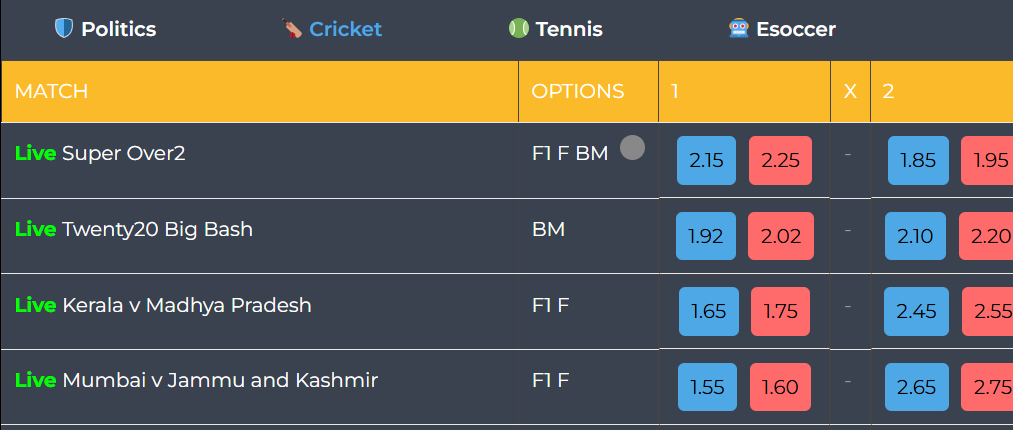
Live in-play markets are cricket-related markets that become available or change while a match is being played. Instead of considering only the expected winner before the toss, users can follow different match situations as they develop.
For example, during a T20 match, the available markets may relate to:
- Match winner
- Next over performance
- Total runs in an innings
- Individual player performance
- Next wicket
- Over-by-over scoring
- Session or innings outcomes
The availability of these markets depends on the match, platform coverage, and market conditions.
The most important difference between pre-match and live markets is timing. Pre-match markets are based on information available before the first ball, whereas live markets continuously respond to events taking place on the field.
2. How Sky Exchange Live Cricket Markets Work
Sky Exchange users interested in live cricket can explore the cricket section and review the markets available for a particular fixture.
The general process involves understanding the match, reviewing the displayed market information, and recognising that prices and availability may change throughout the game.
Here is how the experience generally works:
Step 1: Select a cricket match
Start by identifying the fixture you want to follow. Depending on platform coverage, matches may include international cricket, domestic competitions, T20 leagues, and other tournaments.
Step 2: Explore the available markets
Open the selected fixture and review the available options. Different matches can have different market selections depending on the competition and stage of the game.
Step 3: Understand the displayed odds
Odds represent the market’s pricing of a particular outcome. They can change as the match develops and should not be treated as guaranteed probabilities or predictions.
Step 4: Follow live match developments
Keep track of the score, wickets, overs remaining, and other relevant match information. Live market conditions can change quickly following important events.
Step 5: Review market rules
Before participating, understand the applicable settlement rules, suspended-market conditions, and platform terms. Never assume that every market follows identical rules.
3. Popular Types of Live Cricket Markets
Understanding the different market categories helps readers become familiar with live cricket terminology.
Match Winner Market
The match winner market focuses on which team will win the fixture. Before the match, expectations are generally influenced by team strength, recent form, and playing conditions.
During the match, the situation can change significantly. A team losing early wickets may see its position weaken, while a strong partnership can improve its chances.
Over Runs Market
Over runs markets relate to the number of runs scored during a particular over or a specified group of overs.
For example, a T20 team might score 12 runs in one over and only 4 in the next. Such variations demonstrate why individual overs can have a different impact on the overall innings.
Total Innings Runs
This market focuses on the total runs scored by a team during its innings. The expected total can be influenced by the batting lineup, remaining wickets, overs available, pitch conditions, and scoring rate.
A team scoring quickly during the powerplay may create a different match situation from one that begins cautiously.
Player Performance Markets
Some cricket fixtures may feature markets connected with individual players. These can include runs scored by a batter, wickets taken by a bowler, or other player-related performances.
Player availability, batting position, bowling allocation, and match conditions are important considerations when understanding these markets.
Next Wicket Market
The next wicket market focuses on which team will lose its next wicket or when the next dismissal might occur, depending on the market format.
Batting partnerships, bowling changes, field placements, and the condition of the pitch can all influence the situation.
It is important to remember that none of these factors guarantees a particular result.
4. Important Factors to Understand Before Following Live Markets
Live cricket requires attention to more than just the scoreboard. Several match-related elements can influence how the game develops.
Current Run Rate and Required Run Rate
The current run rate shows how quickly a batting team is scoring. The required run rate indicates the scoring speed needed to achieve a target within the remaining overs.
For example, if a team requires 60 runs from 30 balls, its required run rate is 12 runs per over.
This information helps explain the pressure on the batting side, although the number of wickets remaining and the players at the crease also matter.
Wickets in Hand
A team with eight wickets remaining has more batting resources available than a team with only two wickets remaining.
However, wickets alone do not tell the complete story. The quality of the remaining batters, their current form, and their ability to handle pressure are equally important.
Pitch and Weather Conditions
Pitch conditions can influence batting and bowling performances. Some surfaces offer assistance to fast bowlers, while others provide more opportunities for spin.
Weather can also interrupt play, reduce the number of available overs, or affect the official result.
Powerplay Performance
The powerplay is an important phase in limited-overs cricket. Fielding restrictions create opportunities for batters to score boundaries, although early wickets can change the direction of an innings.
Understanding the powerplay provides useful context when following T20 and ODI matches.
Bowling Changes
Captains regularly adjust their bowling combinations according to match conditions. A change of bowler can influence scoring patterns, particularly when a specialist bowler enters during a difficult phase.
However, one successful over should not automatically be treated as evidence that the entire match has changed.
5. Understanding Odds Movement in Live Cricket
One of the defining features of live markets is changing odds.
Odds can move after important match events, including:
- A batter hitting consecutive boundaries.
- A wicket falling during a partnership.
- A bowler delivering a successful over.
- A team completing a strong powerplay.
- A batting side losing momentum.
- Rain interruptions or changes to the playing conditions.
Consider a hypothetical T20 match in which Team A needs 45 runs from the final four overs.
If two experienced batters are at the crease, the market may reflect one set of expectations. If a wicket falls immediately afterwards, the displayed odds may change.
This is because market pricing responds to updated information and the perceived likelihood of different outcomes.
An important point: Shorter odds do not mean a guaranteed result, and higher odds do not automatically represent better value. Market prices can change rapidly, and users should avoid making decisions based solely on sudden movements.
6. Common Mistakes to Avoid in Live Cricket Markets
Newcomers sometimes make avoidable mistakes because they focus too heavily on individual deliveries rather than the wider match situation.
Here are some common mistakes worth understanding.
Following emotions instead of match information: Supporting a particular team can create bias. It is important to separate personal loyalty from objective match analysis.
Ignoring the number of wickets remaining: Runs and overs are important, but wickets can significantly influence a team’s ability to finish an innings.
Reacting to every boundary: A single boundary does not necessarily change the overall direction of a match. The wider situation matters.
Ignoring market rules: Different markets can have different settlement conditions. Always read the relevant rules before participating.
Chasing previous losses: Trying to recover losses through additional participation can lead to poor financial decisions. Taking a break is a better approach.
Using delayed information: Live scorecards, television coverage, and online commentary may not update simultaneously. A delay can make the information you are viewing different from the information reflected in a live market.
Read Also: How to Check a Card Game Result | Best Sky Exchange Promotions for Existing Customers in 2026 | Ranji Trophy Final 2026 | Sky Exchange XYZ – Complete Informational Guide
7. Why Market Rules and Live Updates Matter
Market rules are an essential part of understanding any live cricket platform. Users should never assume that all markets are settled in the same way.
For example, a rain-affected ODI or T20 match may have a revised target or a reduced number of overs. An abandoned fixture can also have different settlement implications depending on the specific market.
Technical interruptions, suspended markets, incorrect score information, and delayed updates are additional situations worth understanding.
Before participating through SkyExchange, users should review the applicable terms, market-specific information, and settlement conditions.
A good understanding of the rules helps avoid confusion when a match does not follow its original schedule.
8. Responsible Participation in Live Cricket Markets
Live cricket markets can move quickly, which makes responsible participation especially important. The excitement of following a close match should never lead to decisions that negatively affect personal finances.
Consider these practical guidelines:
- Set a fixed budget: Decide how much you can comfortably afford to spend before participating.
- Set time limits: Avoid spending excessive time following live markets.
- Never chase losses: Previous losses should not influence future financial decisions.
- Avoid impulsive decisions: Do not react emotionally to wickets, boundaries, or changing odds.
- Understand the risks: No cricket analysis or prediction can guarantee an outcome.
- Take regular breaks: Step away whenever participation becomes stressful or difficult to control.
Users should also check the laws and eligibility requirements applicable to their location. Online betting is restricted or prohibited in certain jurisdictions, and platform availability does not establish legal permission.
9. Exploring Cricket on Sky Exchange
For cricket enthusiasts interested in understanding online cricket markets, Sky Exchange provides a dedicated cricket section where users can explore the available platform features.
The website is designed around sports-related content and cricket-focused experiences. Users can visit the cricket section to learn more about the platform and its available features.
Useful pages include:
- Sky Exchange Official Website
- Sky Exchange Cricket
- Sky Exchange Login
- Sky Exchange Responsible Gaming Policy
Before using any service, review its terms and conditions, eligibility requirements, and responsible participation guidelines.
Conclusion
Live in-play cricket markets introduce a different way of following the game because the available markets and displayed odds can change as the match progresses. From match winner and total innings runs to over runs and player performance, different market categories reflect different aspects of cricket.
Understanding run rates, wickets in hand, pitch conditions, bowling changes, and match situations can help readers develop a better understanding of live cricket markets.
For anyone exploring Sky Exchange Cricket Betting Live In-Play Markets, knowledge should always come before participation. Understanding market rules, recognising the limitations of live information, and maintaining responsible financial boundaries are essential.
Cricket remains an unpredictable sport. Even the strongest teams and most experienced players cannot guarantee a particular result. Enjoy following the game, stay informed, and make responsible decisions.
Disclaimer: This article is for informational and educational purposes only. It does not guarantee betting outcomes or encourage participation in activities prohibited by applicable local laws. Users should understand the risks and follow responsible gaming practices.
The post A Practical Guide to Sky Exchange Cricket Betting Live In-Play Markets appeared first on Sky Exchange.
]]>The post India vs New Zealand 5th T20I 2026 — Series Finale Preview, Squads and What to Watch in Hamilton appeared first on Sky Exchange.
]]>If you follow cricket through SkyExchange, a series finale like this tends to behave differently from a decider. Teams rotate, odds can look odd, and the toss matters in ways the scorecard doesn’t capture. This preview covers how the series got here, what to expect at Seddon Park, the squads, the match-ups worth your attention and our read on the India vs New Zealand 5th T20I.
India vs New Zealand 5th T20I — Match Details at a Glance
| Detail | Info |
|---|---|
| Match | New Zealand vs India, 5th T20I |
| Series | India tour of New Zealand 2026, five T20Is |
| Date | Sunday, 1 November 2026 |
| Start | 12:30 PM IST (about 8:00 PM local), toss roughly half an hour earlier |
| Venue | Seddon Park, Hamilton |
| Series score | India lead 3-0 |
| Captains | Mitchell Santner (NZ), Shreyas Iyer (India) |
| Live coverage | SkyExchange |
Broadcast listings differ between sources, with some naming JioHotstar and others Sony and DD Sports, so check your own app or TV guide before the toss.
How the India vs New Zealand 5th T20I Became a Series Finale
Three matches, three Indian wins, and each one was won differently.
1st T20I, Christchurch (22 October). New Zealand posted 225 for 4, a total that usually wins in this format. India chased it down with two balls to spare, finishing on 230 for 6. It was tense for most of the chase, and the margin of four wickets tells you how close it was.
2nd T20I, Christchurch (24 October). Even tighter. New Zealand made 180 for 5, and India got there on 181 for 6 with a single ball left. If one delivery had gone differently, this series would look completely different.
3rd T20I, Wellington (27 October). This was the one-sided match. New Zealand made 198 for 3, with Daryl Mitchell unbeaten on 89 and Finn Allen adding 40 after the pair hit eight sixes between them in the first eight overs. India still chased it in 13.2 overs. Abhishek Sharma made 113 and Vaibhav Sooryavanshi 45, and the two put on 118 for no loss in the powerplay, the highest powerplay score in men’s T20Is. India won by six wickets with 40 balls to spare and sealed the series with two games left.
The pattern is hard to miss. New Zealand have scored 225, 180 and 198 batting first and lost every time. That is not a batting problem. It is a bowling and fielding problem, and it is why the India vs New Zealand 5th T20I is more about New Zealand fixing something than India proving anything.
The fourth T20I is at Eden Park in Auckland on Friday, 30 October. India have won all three T20Is they have played at that ground, so check the latest score before you finalise any view on the finale.
Seddon Park — What to Expect in the India vs New Zealand 5th T20I
Seddon Park is a round, well-grassed ground. The India vs New Zealand 5th T20I will be its first men’s T20I since New Zealand played Pakistan there in January 2024, so there is very little recent T20I data from this surface to lean on.
No pitch report had been published at the time of writing, so treat anything you read before the toss as informed guessing. What we do know is that the series has so far produced big totals in Christchurch and Wellington, and nothing suggests Hamilton will behave very differently. The better indicator will be the toss: India chased in all three matches and won all three, so expect any captain who wins the toss to bowl first and take on the target.
India in the India vs New Zealand 5th T20I — A Settled Top Order, Questions Beneath It
India’s squad for the T20I leg is Shreyas Iyer (captain), Tilak Varma (vice-captain), Sanju Samson (wicketkeeper), Ishan Kishan (wicketkeeper), Abhishek Sharma, Vaibhav Sooryavanshi, Shivam Dube, Nitish Kumar Reddy, Axar Patel, Naman Dhir, Prince Yadav, Mayank Yadav, Arshdeep Singh, Bhuvneshwar Kumar, Varun Chakaravarthy and Kuldeep Yadav.
For the 3rd T20I they went with Abhishek, Samson, Sooryavanshi, Iyer, Tilak, Dhir, Reddy, Axar, Bhuvneshwar, Prince Yadav and Arshdeep.
The interesting part of the India vs New Zealand 5th T20I is who comes in. With the series won, India have a squad full of players who have not had a game yet. Ishan Kishan, Shivam Dube, Kuldeep Yadav, Varun Chakaravarthy and Mayank Yadav are all available and unused in that Wellington XI. Expect at least a couple of changes, and expect the wicketkeeper and spin-bowling slots to be the most likely ones to rotate. We are speculating here, since India have not named a team, but the incentive to give everyone a game before the ODIs is strong.
The openers are the story. Abhishek and Sooryavanshi have turned the first six overs into a different sport.
New Zealand in the India vs New Zealand 5th T20I — Runs on the Board, Wins Missing
Mitchell Santner’s side is a 16-man group: Finn Allen, Michael Bracewell, Mark Chapman, Devon Conway, Jacob Duffy, Lockie Ferguson, Zak Foulkes, Matt Henry, Bevon Jacobs, Kyle Jamieson, Adam Milne, Daryl Mitchell, Glenn Phillips, Tim Seifert and Nathan Smith, plus Santner himself.
The batting has delivered. Mitchell’s 89 not out in Wellington was one of the best innings of the series, and Allen has been the kind of opener who can score 40 off 20 balls and change the first eight overs entirely. In Wellington they were 88 for 1 at that stage, which should have been a platform for 220 or more. They finished on 198.
That is the difference between what New Zealand have been doing and what they need to do. Their middle and death overs have lost momentum, and their bowlers have had no answer to India’s powerplay. Even if they bat first and reach 200, the target has not been enough. To win the India vs New Zealand 5th T20I they probably need to do two things: take a wicket in the first three overs, and keep India’s openers under 60 for the powerplay. That has not happened yet in this series.
They won their first ODI series in India in January, and the ODIs on this tour are the next real test. The India vs New Zealand 5th T20I is a chance to find the bowling combination and field placements that work.
Key Battles in the India vs New Zealand 5th T20I
Abhishek Sharma and Vaibhav Sooryavanshi vs the new ball. New Zealand’s best chance of changing the shape of the match is in the first three overs. Kyle Jamieson took two wickets in Wellington, and Lockie Ferguson, Matt Henry and Adam Milne are all options for the new ball. If they can force even one early mistake from the openers, the powerplay score drops by 30 runs.
Daryl Mitchell vs India’s spinners. Mitchell has been New Zealand’s most reliable batter. India have Axar, Kuldeep and Varun available, and the spinner selected will dictate how Mitchell approaches the middle overs. If he can play spin into the leg side the way he did against pace in Wellington, the total goes up quickly.
Finn Allen vs Arshdeep Singh and Bhuvneshwar Kumar. Allen’s early hitting has been the biggest source of New Zealand’s momentum. The test for India’s swing and seam bowlers is whether they can pull the length back in the first two overs, when he looks to attack.
India’s depth vs New Zealand’s death overs. If the chase goes beyond the first ten overs, players like Naman Dhir, Nitish Kumar Reddy and Shivam Dube become the match-winners. New Zealand have conceded runs at the back end all series, so their last five overs will tell us a lot.
India vs New Zealand 5th T20I Prediction — India Favoured, But Not by a Mile
India are the clear favourites. They have won 22 of the T20Is the two sides have played against New Zealand’s 11, according to pre-match listings. They have beaten New Zealand 4-1 in a T20I series at home earlier this year, won the T20 World Cup final by 96 runs in March, and have now won all three matches here.
But there is a reason to be careful with the India vs New Zealand 5th T20I. Series finales with a settled result are often different. India are likely to rotate, and a changed XI is a less cohesive one. New Zealand, meanwhile, have scored big totals and fought hard in the first two matches. They need only one good bowling performance to make this a real contest.
Our read on the India vs New Zealand 5th T20I:
- Likely winner: India, with New Zealand’s best chance coming if they win the toss and bat first.
- Toss: Expect the captain winning it to bowl first.
- Player to watch: Abhishek Sharma for India and Daryl Mitchell for New Zealand.
- Biggest swing factor: whether New Zealand take early wickets.
What Comes After the India vs New Zealand 5th T20I — ODIs and Tests
The five-match ODI series starts on 4 November, and it is a very different contest. Shubman Gill will captain India in the first three ODIs and in the Tests, with Shreyas Iyer taking over as ODI captain for the last two. After the ODIs there are two Tests as part of the 2025-27 World Test Championship cycle, with the second Test finishing on 1 December.
Following the India vs New Zealand 5th T20I on SkyExchange
If you want to follow the match on SkyExchange, the steps are simple:
- Create your SkyExchange ID with your mobile number and OTP.
- Add funds with UPI (Google Pay, PhonePe or Paytm). The minimum deposit is ₹100.
- Log in to SkyExchange and open the cricket section before the toss.
- Markets usually include match winner, top batter and session runs, depending on liquidity.
- Download the SkyExchange app for match-day access on your phone.
A match with a settled series result is a good time to be disciplined. Set a budget before you begin, avoid chasing losses, and treat it as entertainment rather than income.
Frequently Asked Questions
When is the India vs New Zealand 5th T20I? Sunday, 1 November 2026, with the match starting at 12:30 PM IST at Seddon Park in Hamilton.
What is the series score before the India vs New Zealand 5th T20I? India lead 3-0 after the first three matches, so the series is already decided. The fourth T20I is at Eden Park in Auckland on 30 October.
Where is the India vs New Zealand 5th T20I played? At Seddon Park in Hamilton, New Zealand.
Who are the captains? Shreyas Iyer leads India and Mitchell Santner leads New Zealand.
Has India chased in every match this series? Yes. New Zealand batted first in all three matches and India chased successfully each time.
What happens after the T20I series? A five-match ODI series starts on 4 November, followed by two Tests, with the second ending on 1 December.
Where can I follow the match live? Broadcast listings vary between sources, so check your app or TV guide. You can also follow it through SkyExchange after you log in.
This article is for informational purposes only. Please engage with any online platform responsibly. 18+ only. Users are responsible for checking the laws that apply in their own jurisdiction.
The post India vs New Zealand 5th T20I 2026 — Series Finale Preview, Squads and What to Watch in Hamilton appeared first on Sky Exchange.
]]>The post Harry Kane Wins the 2026 Ballon d’Or — The Numbers, The Debate and What Comes Next appeared first on Sky Exchange.
]]>The Harry Kane Ballon d’Or story is not a simple one. It was a year of record-breaking goals and domestic trophies, set against a World Cup that ended in a semi-final defeat and a Champions League campaign that fell short. This article looks at how the night unfolded, the numbers that carried the vote, why the race was argued over for months, and what comes next for a player who has just rewritten the end of his own career story.
If you follow football through SkyExchange, the Harry Kane Ballon d’Or news is also a good moment to look ahead at the Bundesliga and Champions League fixtures where Kane will now be playing as the reigning Ballon d’Or holder.
The Night in London: The Harry Kane Ballon d’Or Ceremony
The 2026 ceremony was the 70th edition of the Ballon d’Or and, for the first time, it was held outside France. Organisers chose London as a nod to Stanley Matthews, the first-ever winner, which made it a fitting stage for an English victory.
The Harry Kane Ballon d’Or win makes him the fifth English winner of the men’s award, after Matthews, Bobby Charlton, Kevin Keegan and Michael Owen. Owen’s win came in 2001, which is where the 25-year gap comes from.
Several other awards went out alongside the Harry Kane Ballon d’Or on the same evening:
| Award | Winner |
|---|---|
| Men’s Ballon d’Or | Harry Kane (Bayern Munich / England) |
| Women’s Ballon d’Or | Alexia Putellas (third win, after 2021 and 2022) |
| Men’s Coach of the Year | Luis de la Fuente (Spain) |
| Women’s Coach of the Year | Pere Romeu (Barcelona) |
| Men’s Young Talent | Lamine Yamal (Barcelona) |
| Men’s Goalkeeper | Unai Simón (Spain) |
| Striker of the Year | Harry Kane and Charlyn Corral |
For Spain, the evening was another reminder of how complete their run has been. De la Fuente’s side won the World Cup this summer, and both the coach and the goalkeeper were recognised. Yamal took the young player award but missed out on the biggest prize he was widely tipped to chase.
The Numbers Behind the Harry Kane Ballon d’Or Win
Voters in this award always talk about trophies, performances and “the big moments”. In the Harry Kane Ballon d’Or case, the first argument was simply goals.
Across the 2025-26 season Kane scored 61 goals in 51 appearances for Bayern in all competitions. Thirty-six of those came in 31 Bundesliga matches, which earned him the European Golden Shoe. Counting his goals for England as well, he finished the period under review with around 73 goals, a total that has been described as the second-highest single-season haul in football history, behind only Lionel Messi’s 82 goals in 2011-12 and ahead of Cristiano Ronaldo’s 69 in the same year.
There was also a landmark earlier this autumn. Kane became the fastest player ever to reach 100 Bundesliga goals, getting there in 98 games. That is 31 matches quicker than Dieter Müller, whose record had stood for almost half a century.
Here is the short version of his case:
| Category | Kane’s 2025-26 record |
|---|---|
| Goals for Bayern (all competitions) | 61 in 51 appearances |
| Bundesliga goals | 36 in 31 matches (European Golden Shoe) |
| Goals for club and country combined | Around 73 |
| Domestic trophies | Bundesliga, DFB-Pokal, German Supercup |
| World Cup goals for England | Six |
| Bundesliga milestone | Fastest to 100 goals (98 games) |
None of that is small. For a striker who spent most of his career at Tottenham without winning a trophy, it also marks a complete turnaround. When he left for Bayern in 2023 the question was whether he would ever hold a major medal. He has now collected two Bundesliga titles and one of the most famous individual awards in the sport.
Why the Harry Kane Ballon d’Or Race Was Argued Over for Months
It would be dishonest to say the Harry Kane Ballon d’Or decision was uncontroversial. The 2026 race was described as unusually open from the moment the World Cup finished.
The case for Yamal. The Barcelona winger would have become the youngest winner in the award’s history. He was a constant threat for Spain at the World Cup, and Barcelona’s results made him an obvious headline name. He finished the evening with the Young Talent award as consolation.
The case for Mbappé. The Real Madrid forward argued publicly in recent weeks that his record as the leading scorer in World Cup history should carry weight. He made the point that no unanimous Ballon d’Or winner has ever ticked every box.
The case for others. Rodri, Khvicha Kvaratskhelia and the Paris Saint-Germain group were all discussed at various points. Messi, at 39, also returned to the conversation after his World Cup run.
The case against Kane. The main objection was straightforward. England’s World Cup ended in a semi-final loss to Argentina, and Bayern did not lift the Champions League. For some voters, the Ballon d’Or still belongs to the player who wins the biggest team prizes.
Before the ceremony, the Harry Kane Ballon d’Or outcome was already the market favourite. One widely reported price had him at 4/7, with Yamal at 9/2 and both Mbappé and Rodri at 8/1. Teammates were openly supportive as well. Serge Gnabry said he believed Kane had “done enough” given the year he had.
Kane himself kept his tone measured through the summer. In August he said the decision was “not in my hands” and that his focus was on the new season.
What the Harry Kane Ballon d’Or Win Means for England
For England, the Harry Kane Ballon d’Or moment is both a celebration and a slightly awkward reminder. The country has now produced a Ballon d’Or winner for the first time in a generation, yet the national team still has not won a major tournament since 1966.
Kane scored six goals at this summer’s World Cup, which helped England reach the last four and formed a big part of the Harry Kane Ballon d’Or argument. The semi-final, a 2-1 defeat to Argentina decided by two late goals, is the part that still stings. Kane will now be the player whose career is judged against exactly that gap: individual brilliance on one side, team silverware on the other.
At the same time, the award adds weight to his standing in the squad. With the next European and World Cup cycles ahead, England’s coaching staff will lean heavily on a captain who has just been named the best player in the world.
What the Harry Kane Ballon d’Or Win Means for Bayern
At club level, the picture is simpler. With the Harry Kane Ballon d’Or now in the cabinet, Bayern have a reigning holder leading their attack, and he is still scoring. The season is already underway, and Kane recently set up a goal in a 2-2 Champions League draw with Arsenal at the Allianz Arena, a result that kept Bayern’s European campaign alive heading into the next matchdays.
Bayern fans will hope the trophy gives him extra motivation rather than extra pressure. Kane has been open about the fact that the Champions League is the prize he wants most. A Ballon d’Or winner without that medal would still carry an unfinished storyline into the second half of his career.
What Happens Next After the Harry Kane Ballon d’Or Win
The immediate calendar is busy:
- Bundesliga: Bayern are defending their title, with Kane expected to lead the scoring charts again.
- Champions League: The league phase continues, with Kane chasing the one trophy missing from his collection.
- England: Fixtures return in the coming international windows, with World Cup disappointment still fresh.
There is also the question of how far the goals can go now that the Harry Kane Ballon d’Or is his. Having reached 100 Bundesliga goals in record time, Kane is now one of the most prolific forwards in the competition’s history, and there is no obvious reason his pace should drop soon.
A Final Word on the Harry Kane Ballon d’Or
The Harry Kane Ballon d’Or win is, in the end, a story about patience. A player who waited years for his first major trophy has now collected one of the most prestigious honours in the sport, and he did it in his home city. Whatever the debate about the vote, the Harry Kane Ballon d’Or result is now part of football history.
Following the Season on SkyExchange
If you like to follow football closely, SkyExchange covers major European competition alongside cricket. To get started:
- Visit skyexchange.social and create your SkyExchange ID with your mobile number.
- Add funds with UPI (Google Pay, PhonePe or Paytm). The minimum deposit is ₹100.
- Log in to SkyExchange and open the football section to see upcoming Bundesliga and Champions League fixtures.
- Download the SkyExchange app if you want match-day access on your phone.
As always, treat any activity on the platform as entertainment. Set a budget before you begin and stop when you reach it.
Frequently Asked Questions
Who won the 2026 Ballon d’Or? Harry Kane won the men’s Ballon d’Or on Monday 26 October 2026, beating Kylian Mbappé and Lamine Yamal at a ceremony in London.
Where was the 2026 Ballon d’Or ceremony held? At the Palladium Theatre in London. It was the first time the ceremony took place outside France, marking the award’s 70th edition.
When did an English player last win the Ballon d’Or? Michael Owen in 2001. Kane is the fifth English winner overall, after Stanley Matthews, Bobby Charlton, Kevin Keegan and Owen.
How many goals led to the Harry Kane Ballon d’Or win? He scored 61 goals in 51 games for Bayern Munich in 2025-26, including 36 in the Bundesliga, and around 73 once his England goals are included.
When was the Harry Kane Ballon d’Or announced? On Monday 26 October 2026 at the Palladium Theatre in London.
Who won the Women’s Ballon d’Or in 2026? Alexia Putellas, who claimed the award for the third time after winning in 2021 and 2022.
Did Kane win a trophy at Bayern last season? Yes. He won the Bundesliga, the DFB-Pokal and the German Supercup.
This article is for informational purposes only. Please engage with any online platform responsibly. 18+ only. Users are responsible for checking the laws that apply in their own jurisdiction.
The post Harry Kane Wins the 2026 Ballon d’Or — The Numbers, The Debate and What Comes Next appeared first on Sky Exchange.
]]>The post Asian Games 2026 Final: India Beat Pakistan to Win Gold appeared first on Sky Exchange.
]]>IN the Sky exchange analysis, Abhishek Sharma provided India with an explosive start, Tilak Varma produced a crucial unbeaten half-century, and Shivam Dube contributed with both bat and ball as India held their nerve in the closing stages. For Pakistan, Hasan Nawaz produced a remarkable 96 from 51 balls, but his effort was ultimately not enough to take his team to the gold medal.
For cricket followers searching for Asian Games 2026 cricket results, India vs Pakistan Asian Games 2026, Asian Games cricket final and T20 cricket updates, the final became one of the standout matches of the tournament.
India Win Asian Games 2026 Cricket Gold
India entered the final as the defending Asian Games men’s cricket champions and completed their campaign with another gold medal.
After winning the toss, India captain Shreyas Iyer elected to bat first. The decision immediately paid off as India’s openers attacked the Pakistan bowling attack during the powerplay.
India raced to 50 in only 3.2 overs before Abhishek Sharma continued his aggressive approach. The left-handed opener eventually scored 61 runs from just 28 deliveries, providing the foundation for a huge Indian total.
His innings included three fours and seven sixes and demonstrated the importance of a fast start in T20 cricket.
Abhishek Sharma Sets the Platform
Abhishek Sharma was one of the biggest reasons India were able to reach such a challenging total.
Pakistan struggled to contain India’s attacking approach during the opening overs. Their bowlers repeatedly missed their lengths, allowing Abhishek to take advantage of deliveries that offered scoring opportunities.
He brought up his half-century from just 20 balls before eventually being dismissed by Arafat Minhas.
Although India lost wickets during the middle overs, Abhishek’s quick 61 had already given the team significant momentum.
For fans following Sky Exchange cricket and international T20 matches, the innings demonstrated how important powerplay scoring can be when assessing the development of a short-format game.
Tilak Varma and Shivam Dube Finish Strong
India appeared to lose some momentum during the middle portion of the innings.
Pakistan’s bowlers tightened their lines and India went through a period of 34 deliveries without a boundary. The match changed again when Tilak Varma broke the boundary drought.
Tilak finished the innings in spectacular fashion.
He scored an unbeaten 51 from only 22 balls and attacked Pakistan’s bowlers during the closing overs. Shivam Dube also played an important cameo, scoring 27 runs.
The pair added a crucial sixth-wicket partnership that helped India move beyond the 200-run mark.
India eventually finished on:
India: 211/6 in 20 overs
- Abhishek Sharma – 61 off 28
- Tilak Varma – 51* off 22
- Shivam Dube – 27
- Arafat Minhas – 2/25
- Ahmed Daniyal – 2 wickets
The total became the highest match total of the Asian Games men’s cricket competition.
Pakistan Begin the Chase Under Pressure
Pakistan required 212 runs to win the Asian Games 2026 gold medal.
The chase did not begin according to plan.
India’s bowlers created early pressure and Pakistan reached only 39/3 during the powerplay. Axar Patel and Washington Sundar played important roles during the early phase, while Jasprit Bumrah’s pace and bounce made scoring difficult.
At that stage, India’s position appeared strong.
However, Pakistan were not ready to give up.
Hasan Nawaz Keeps Pakistan Alive
Hasan Nawaz produced one of the outstanding individual performances of the Asian Games final.
After Pakistan lost early wickets, Nawaz joined Saim Ayub and began rebuilding the innings. The pair put together an 87-run partnership that brought Pakistan back into contention.
Nawaz continued attacking as the required run rate increased.
He reached his half-century from 28 balls and continued scoring boundaries deep into the innings. His final score was an impressive 96 from 51 deliveries, including five fours and seven sixes.
Saim Ayub contributed 29 from 22 balls before Shivam Dube dismissed him.
Pakistan still needed 68 runs from the final four overs, leaving India with very little room for error.
Read Also: India vs Pakistan Asia cup Final | India vs Pakistan | India vs pakistan
India Hold Their Nerve in the Final Overs
The closing stages produced the tension expected from an India-Pakistan final.
Pakistan continued to attack, but India’s bowlers managed to keep the required rate under pressure.
Washington Sundar delivered a crucial 18th over, dismissing Abdul Samad and conceding only eight runs apart from a final-ball six.
Jasprit Bumrah then bowled the penultimate over.
With Pakistan requiring 33 runs from the final six deliveries, Shivam Dube was handed the ball for the last over.
Pakistan added a boundary and a wide early in the over, but Dube responded with a yorker that effectively ended Pakistan’s hopes of completing the chase.
Hasan Nawaz was eventually dismissed from the final delivery.
Pakistan finished on:
Pakistan: 192/6 in 20 overs
- Hasan Nawaz – 96 off 51
- Saim Ayub – 29 off 22
- Maaz Sadaqat – 23
- Axar Patel – 2/29
- Washington Sundar – 2/29
- Shivam Dube – 2/33
India won by 19 runs.
India vs Pakistan Asian Games 2026 Final: Match Summary
| Team | Score | Result |
|---|---|---|
| India | 211/6 | Won |
| Pakistan | 192/6 | Lost |
| Winning margin | 19 runs | India |
| Format | T20 | Gold Medal Match |
| Venue | Korogi Sports Park, Nisshin | Japan |
The result gave India their second consecutive gold medal in the men’s cricket competition at the Asian Games.
Pakistan finished with the silver medal.
Sri Lanka Take the Bronze Medal
The bronze-medal match was also played on October 3, with Sri Lanka facing Bangladesh.
Sri Lanka scored 165/9 before restricting Bangladesh to 102 all out, winning by 63 runs.
All-rounder Tharindu Ratnayake played a major role, scoring 65 from 32 deliveries and later contributing with the ball.
The result meant Sri Lanka claimed the bronze medal, while Bangladesh finished fourth.
Asian Games 2026 Men’s Cricket: Final Standings
The medal positions were:
Gold – India
Silver – Pakistan
Bronze – Sri Lanka
Fourth – Bangladesh
India therefore completed another successful Asian Games men’s cricket campaign.
Asian Games Cricket 2026: Key Performances
Several players made a major impact throughout the tournament.
Abhishek Sharma
Abhishek’s 61 from 28 balls in the final gave India the perfect start. His power-hitting during the opening overs put Pakistan under immediate pressure.
Tilak Varma
Tilak Varma finished unbeaten on 51 from 22 deliveries. His late acceleration helped India cross the 200-run mark.
Shivam Dube
Dube contributed 27 runs and later claimed two wickets, including the final wicket of Hasan Nawaz.
Hasan Nawaz
Pakistan’s Hasan Nawaz delivered the highest individual score of the final, making 96 from 51 balls. His innings kept Pakistan’s chase alive until the final delivery.
Washington Sundar
Washington played an important role with the ball, taking two wickets and bowling a critical 18th over during Pakistan’s chase.
What the Asian Games 2026 Final Means for T20 Cricket
The India-Pakistan final showed how quickly momentum can change in T20 cricket.
India’s fast start created the foundation for 211 runs, while Pakistan’s middle-order recovery brought the chase back into the contest. The final overs ultimately decided the result.
For readers following T20 cricket 2026, the match also provides several useful areas to examine, including:
- Powerplay scoring
- Middle-over partnerships
- Death-over batting
- Bowling changes
- Required run rate
- Wicket-taking opportunities
- Fielding pressure
- Batting depth
These elements are particularly important when following live T20 matches and understanding how match situations change from one over to the next.
Following Cricket on Sky Exchange
The Asian Games final adds another major international T20 match to the 2026 cricket calendar.
Readers searching for Sky Exchange cricket, Sky Exchange live cricket, Sky Exchange ID, Sky Exchange login, Sky Exchange app, Sky Exchange VIP and skyexchange can follow major cricket competitions alongside tournament schedules, results and match information.
For anyone researching cricket markets on Sky Exchange, it is useful to study confirmed team news, playing XIs, recent performances, pitch conditions and match statistics before making any decisions.
Users should also check the laws and regulations applicable in their location before accessing online gaming or wagering services.
Sky Exchange Cricket Keywords for Asian Games 2026
This Asian Games cricket story is relevant to searches such as:
- Asian Games 2026 cricket
- Asian Games 2026 men’s cricket
- Asian Games cricket final
- Asian Games cricket results
- India vs Pakistan Asian Games 2026
- India Pakistan cricket final
- Asian Games 2026 gold medal
- T20 cricket 2026
- India cricket news
- Pakistan cricket news
- Sky Exchange cricket
- Sky Exchange live cricket
- Sky Exchange ID
- Sky Exchange login
- Sky Exchange app
- Sky Exchange VIP
- Sky Exchange sports
- skyexchange
Final Thoughts
India’s 19-run victory over Pakistan completed a memorable Asian Games 2026 men’s cricket tournament.
Abhishek Sharma’s explosive 61 established India’s platform, while Tilak Varma’s unbeaten 51 and Shivam Dube’s late contribution pushed India to 211/6. Pakistan responded strongly through Hasan Nawaz, whose 96 from 51 balls kept the contest alive until the final delivery.
However, India’s bowling attack managed the decisive moments better and restricted Pakistan to 192/6.
With this victory, India retained the Asian Games men’s cricket gold medal, Pakistan collected silver and Sri Lanka secured bronze.
For cricket fans following Asian Games 2026, India vs Pakistan, T20 cricket, Sky Exchange cricket and the latest international cricket results, the final will remain one of the defining matches of the tournament.
The post Asian Games 2026 Final: India Beat Pakistan to Win Gold appeared first on Sky Exchange.
]]>The post India Beat Afghanistan in 1st T20I as Women’s Team Crowned Asia Cup Champions appeared first on Sky Exchange.
]]>For cricket fans following every major match, Sky Exchange offers a convenient platform to stay connected with sports and live cricket action. From checking the latest Sky Exchange cricket updates to exploring match-related markets, users can access the platform through their Sky Exchange ID, complete a quick Sky Exchange login, and use the Sky Exchange app for a mobile-friendly experience. As India celebrates victories across both men’s and women’s cricket, Sky Exchange users can continue following match results, player performances, upcoming fixtures, and tournament developments in one place.
India’s men’s side defeated Afghanistan by seven wickets in the first T20I at New Delhi, taking a 1-0 lead in the three-match series. Later, India’s women’s team produced an outstanding performance against Sri Lanka in the Women’s Asia Cup final, winning by 72 runs to become continental champions.

The two results made it a special day for Indian cricket, with both teams delivering impressive performances on the same day.
India Dominate Afghanistan in First T20I
India started their T20I series against Afghanistan in emphatic fashion at the Arun Jaitley Stadium in New Delhi.
After being asked to bat first, Afghanistan recovered from a difficult start to post 156/6 in their 20 overs. The visitors lost early wickets, including Rahmanullah Gurbaz, who was dismissed by Jasprit Bumrah in the opening over.
Afghanistan were reduced to 41/4 during the powerplay before Azmatullah Omarzai and Mohammad Nabi launched a counterattack. Omarzai scored an unbeaten 64 from 44 balls, while Nabi contributed 33 from 27 balls. Their partnership helped Afghanistan reach a competitive 156.
Arshdeep Singh was India’s leading bowler, finishing with impressive figures of 3/19. Bumrah, Axar Patel and Varun Chakravarthy also picked up one wicket each.
Abhishek Sharma Produces a Stunning Knock
India’s chase was dominated by Abhishek Sharma.
The left-handed opener smashed 82 runs from just 32 deliveries, hitting seven sixes and seven fours. His explosive innings gave India complete control of the chase and helped them reach the target with 38 balls remaining.
Ishan Kishan provided valuable support with 42 from 33 balls. After Sanju Samson was dismissed for 10, Kishan helped steady the innings before India accelerated towards victory.
India eventually reached 157/3 in only 13.4 overs. Shreyas Iyer and Tilak Varma completed the chase, giving India a comfortable seven-wicket victory.
The result gives India a 1-0 advantage in the three-match series, with the second T20I scheduled to follow shortly.
India Women Crowned Asia Cup Champions
The celebrations continued in Dubai, where India’s women’s team delivered a dominant performance against Sri Lanka in the Women’s Asia Cup 2026 final.
India won the final by 72 runs after posting an imposing 183/5 before bowling Sri Lanka out for 111. The victory secured India’s eighth Women’s Asia Cup title.
It was a comprehensive performance from India, with the batting unit producing a strong total before the bowlers completed the job.
Shafali Verma and Smriti Mandhana Lead the Batting
India’s innings was built around an excellent opening partnership between Shafali Verma and Smriti Mandhana.
Shafali produced an explosive 68, including the fastest fifty in Women’s Asia Cup history, reaching the landmark in only 24 balls. Mandhana played an equally important role with a composed 59. The pair added 129 runs, giving India an excellent platform.
India finished their 20 overs on 183/5, leaving Sri Lanka with a difficult target.
Read Also: Ranji Trophy Plate 2026-27 | India vs Sri Lanka Series 2026 | 10 Common Betting Mistakes to Avoid | Sky Exchange APK Installation Errors and App Fixes | SkyExchange Master ID Guide
Sree Charani Stars With the Ball
Sri Lanka’s chase never gained momentum as India’s bowling attack applied pressure from the beginning.
Sree Charani was the standout performer, taking four wickets for 20 runs. Deepti Sharma also played an important role with her controlled spell as India’s bowlers dismantled the Sri Lankan batting order.
Sri Lanka were eventually bowled out for 111, giving India a comprehensive 72-run victory.
A Memorable Day for Indian Cricket
The men’s and women’s results together created an exceptional day for Indian cricket.
The men’s team showed its aggressive T20 approach through Abhishek Sharma’s explosive innings and a disciplined bowling effort from Arshdeep Singh. Meanwhile, the women’s team combined powerful batting from Shafali and Mandhana with an excellent spin-bowling display to secure another major international title.
The Women’s Asia Cup victory also underlined India’s strength in women’s cricket, while the men’s win provided an encouraging start to the Afghanistan T20I series.
What These Results Mean for India
India’s double success provides plenty of positives heading into the next phase of the international calendar.
For the men’s team, the immediate focus will be on maintaining momentum against Afghanistan. Abhishek Sharma’s form will be particularly encouraging after his match-winning 82, while India’s bowling attack demonstrated its ability to restrict Afghanistan despite Omarzai and Nabi’s recovery partnership.
For the women’s team, the Asia Cup triumph provides another significant milestone. India’s balanced squad showed that it can win through both batting depth and bowling quality.
The tournament also highlighted the importance of players such as Shafali Verma, Smriti Mandhana, Deepti Sharma and Sree Charani.
Sky Exchange Cricket Fans Have Plenty to Follow
With India’s men’s team leading Afghanistan 1-0 and the women’s team celebrating an Asia Cup championship, Indian cricket fans have plenty to look forward to.
The Afghanistan T20I series will provide further opportunities to assess India’s emerging T20 combinations, while the women’s Asia Cup success gives Indian fans another major international title to celebrate.
For cricket followers looking at match schedules, team performances, player form and upcoming fixtures, these matches provide plenty of talking points.
Sky Exchange readers can continue following the latest cricket news, match previews, score updates and tournament developments as India’s international calendar moves forward.
Final Thoughts
September 13, 2026, will be remembered as a special day for Indian cricket.
India’s men’s team opened its T20I series against Afghanistan with a commanding seven-wicket victory, powered by Abhishek Sharma’s breathtaking 82 from 32 balls.
On the same day, India’s women’s team completed a dominant Women’s Asia Cup campaign by defeating Sri Lanka by 72 runs in Dubai. Shafali Verma and Smriti Mandhana provided the batting foundation, while Sree Charani led the bowling attack with four wickets.
Two teams, two major victories and one unforgettable day for Indian cricket.
The post India Beat Afghanistan in 1st T20I as Women’s Team Crowned Asia Cup Champions appeared first on Sky Exchange.
]]>The post Ranji Trophy Plate 2026-27: Everything You Need to Know Before Betting on Sky Exchange appeared first on Sky Exchange.
]]>Understanding the Ranji Trophy Plate Group
The Plate Group sits below the four Elite groups in the Ranji Trophy structure and typically features the North Eastern states and smaller cricketing associations competing for a place among India’s cricketing elite. The format rewards consistency and depth, with teams playing a round-robin league before the top finishers progress to knockout stages.
Historically, the Plate Group has served as a proving ground for teams like Sikkim, Nagaland, Mizoram, Manipur, Meghalaya, and Arunachal Pradesh, all of whom have used strong Plate campaigns to push for promotion in recent seasons. The winner of the Plate Group earns promotion to the Elite category for the following season, making every match count in the race for advancement.
Key Dates for the 2026-27 Season
The 2026-27 domestic cricket calendar kicks off with the Duleep Trophy in August, followed by the Irani Cup in early October, before the Ranji Trophy itself begins on October 11. This season introduces a split two-phase format designed to protect players from harsh winter conditions in northern India, with the first phase running until early November and the second phase resuming in mid-January through the knockout rounds.
For Plate Group followers, this means an early start to league fixtures in October, followed by a break during the white-ball domestic season, before action resumes in the new year as teams push for a place in the knockout stages.
Teams to Watch in the Plate Group
The Plate Group continues to showcase competitive cricket from India’s North Eastern states and other developing cricketing regions. Teams such as Manipur, Mizoram, Sikkim, Nagaland, Meghalaya, and Arunachal Pradesh typically form the core of this group, each bringing distinct strengths shaped by their playing conditions and squad depth.
Nagaland and Sikkim have historically punched above their weight in recent Plate campaigns, often finishing near the top of the table and pushing for promotion. Meanwhile, teams like Mizoram and Manipur have shown flashes of quality that make them dangerous floaters capable of upsetting the established order on their day.
Why the Plate Group Matters for Bettors
While the Elite groups often attract more mainstream attention, the Plate Group offers unique value for bettors who take the time to study team form and player performances closely. Markets here can carry attractive odds due to less predictable outcomes, especially in matches between closely matched sides where home conditions and squad availability play a significant role.
Before diving into Plate Group betting, make sure you’ve completed your registration and received your Sky Exchange ID, giving you full access to domestic cricket markets throughout the season. Access to these markets is available anytime through the Sky Exchange login portal, allowing you to follow matches and place bets as fixtures unfold.
Betting Markets Available for Plate Group Matches
Domestic first-class cricket typically offers a slightly different set of markets compared to international limited-overs cricket, given the longer format and different result possibilities. Common markets for Plate Group matches include:
Match Result: Predicting whether a match will end in a win, loss, or draw, accounting for the possibility of a first-innings lead deciding points in drawn matches.
Top Run Scorer: Betting on which batsman will accumulate the most runs across the match, factoring in pitch conditions and team batting depth.
Total Match Wickets: Wagering on the combined number of wickets to fall across the match, which can be influenced heavily by pitch behavior over four days.
Session Betting: For those who enjoy following the ebb and flow of a Test-format match, session betting offers opportunities to engage with the game session by session rather than waiting for the final result.
Analyzing Plate Group Form and Conditions
Success in Plate Group betting often comes down to understanding conditions specific to North Eastern venues, where pitches can behave differently compared to the more familiar surfaces used in Elite group cricket. Many Plate Group matches are played on surfaces that favor seam bowling early before flattening out, making toss decisions and first-innings performances particularly important indicators.
Squad availability is another crucial factor, as smaller state associations sometimes see key players called up for India A duty or other representative cricket, which can significantly impact team balance for specific fixtures. Staying updated on team news before placing bets is essential for anyone serious about Plate Group betting.
For deeper statistical analysis, including historical head-to-head data and player performance trends specific to domestic cricket, Sky Exchange Biz provides the advanced tools needed to make more informed decisions throughout the Plate Group season.
The Road to Promotion
The ultimate prize for Plate Group teams is promotion to the Elite category, a achievement that brings greater recognition, tougher competition, and often better player retention for the following season. Teams that finish at the top of the round-robin standings advance to knockout fixtures, where a single strong performance can define an entire campaign.
Following this promotion race adds an extra layer of intrigue to Plate Group betting, as teams fighting for that final promotion spot often display increased intensity and more aggressive team selections as the season progresses toward its climax.
Tips for Betting on Ranji Trophy Plate Matches
Given the longer format and lower profile of Plate Group cricket compared to international fixtures, doing your homework pays off significantly. Follow domestic cricket news sources for team announcements, pitch reports, and injury updates before placing bets on specific matches.
Pay close attention to toss results, as winning the toss and choosing to bat first often provides a meaningful advantage in first-class cricket, particularly on pitches that tend to deteriorate over the course of a four-day match. Consider starting with smaller stakes as you familiarize yourself with the nuances of domestic cricket betting, gradually increasing your involvement as you build confidence in reading team form and conditions.
Conclusion
The Ranji Trophy Plate Group 2026-27 season promises to deliver the same competitive spirit and promotion drama that has made this section of Indian domestic cricket so compelling in recent years. With teams like Nagaland, Sikkim, Mizoram, Manipur, Meghalaya, and Arunachal Pradesh all vying for a place among the elite, there’s plenty for cricket fans and bettors to follow throughout the season.
Whether you’re a seasoned domestic cricket follower or new to Plate Group betting, Sky Exchange provides the platform, markets, and tools needed to engage with this exciting competition. Set up your Sky Exchange ID, access matches easily through the Sky Exchange login portal, and explore advanced analytics via Sky Exchange Biz to make the most informed decisions as the Plate Group race unfolds this season.
As always, approach domestic cricket betting responsibly, treating it as an enjoyable way to follow the sport’s grassroots talent rather than a guaranteed source of profit.
The post Ranji Trophy Plate 2026-27: Everything You Need to Know Before Betting on Sky Exchange appeared first on Sky Exchange.
]]>The post SkyExchange Master ID Guide — How to Become an Agent in 2026 appeared first on Sky Exchange.
]]>This guide covers everything about the SkyExchange Master ID — what it is, how it differs from a standard account, who it is designed for, how to apply, and how experienced agents use the SkyExchange Biz APK to run their networks efficiently.
What Is a SkyExchange Master ID?
A SkyExchange Master ID is an agent-level account on the SkyExchange platform. Unlike a standard SkyExchange ID — which is a single user account giving access to betting markets, casino games, and your personal wallet — a SkyExchange Master ID is a management account that sits above standard user accounts in the platform hierarchy.
A SkyExchange Master ID holder can:
- Create new standard SkyExchange IDs for other users
- Manage multiple sub-accounts from a single dashboard
- Set betting limits and deposit parameters for each sub-account
- Track activity, balances, and wagering across all managed accounts
- Earn commission on the activity generated by sub-accounts
- Access the SkyExchange Biz APK — a dedicated agent management application
The SkyExchange Master ID system is the primary way the platform has scaled its user base across India. Rather than relying entirely on direct registrations, SkyExchange works with a network of trusted agents who distribute IDs, support local users, and earn a commission income from their network’s activity.
SkyExchange Master ID vs Standard SkyExchange ID
Understanding the difference between the two account types is essential before applying for a SkyExchange Master ID.
| Feature | Standard SkyExchange ID | SkyExchange Master ID |
|---|---|---|
| Account purpose | Personal betting & casino | Agent management |
| Sub-account creation | No | Yes — unlimited |
| Commission earnings | No | Yes — from sub-accounts |
| SkyExchange Biz APK | No | Yes |
| Dashboard | Personal wallet & history | Full network management |
| Betting limits | Standard user limits | Elevated + set limits for sub-accounts |
| Support tier | Standard 24/7 | Priority agent support |
| Minimum experience | None | Existing SkyExchange account recommended |
The SkyExchange Master ID is not a replacement for a standard ID — many Master ID holders maintain a separate standard account for their own personal betting activity, using the Master ID exclusively for agent management.
Who Is a SkyExchange Master ID Designed For?
The SkyExchange Master ID is specifically designed for three types of users:
1. Established bettors with a strong personal network If you have friends, family, or community members who regularly ask you to help them access SkyExchange betting markets, a Master ID formalises that relationship into a structured, commission-earning agent arrangement.
2. Digital entrepreneurs and online community managers Telegram channel operators, sports prediction community managers, and WhatsApp group admins who provide cricket tips, match previews, and betting guidance to a regular audience are natural candidates for a SkyExchange Master ID. Their existing audience becomes their potential sub-account network.
3. Experienced bettors looking to add a commission income stream For users who are already active on SkyExchange and understand the platform deeply, a Master ID creates a secondary income source — commission earnings from sub-account activity — that runs alongside their own betting without requiring additional capital at risk.
How the SkyExchange Master ID Commission System Works
Commission is the primary financial benefit of holding a SkyExchange Master ID. The commission structure rewards Master ID holders based on the net activity generated by their sub-accounts.
How commission is calculated:
The platform calculates the net result across all activity on your sub-accounts within a defined period. The Master ID holder receives a percentage of this net as commission — the exact percentage is confirmed at the time of Master ID application and varies based on the volume commitment and agreement terms.
Key commission principles:
- Commission is earned on net sub-account activity — not on individual bets
- Higher sub-account volume generates higher overall commission potential
- Commission is credited to your SkyExchange Master ID wallet on the agreed schedule
- There is no cap on the number of sub-accounts a single SkyExchange Master ID can manage
This model means that building a larger, more active sub-account network directly increases commission earnings. A Master ID holder with 50 active sub-accounts consistently earns more commission than one with 5 — the incentive structure rewards growth.
SkyExchange Biz APK — The Agent Management Tool
The SkyExchange Biz APK is a separate application designed exclusively for SkyExchange Master ID holders. It is distinct from the standard SkyExchange App used by regular users — it has a completely different interface built around agent management rather than personal betting.
What the SkyExchange Biz APK does:
Sub-account creation panel — Create new SkyExchange IDs for users directly from the Biz APK without contacting central support. Set usernames, temporary passwords, and initial deposit parameters for each new account.
Network dashboard — A real-time overview of all sub-accounts showing current balances, recent activity, win/loss positions, and active sessions. You can see at a glance which sub-accounts are active, which have pending deposits or withdrawals, and which have not logged in recently.
Limit management — Set individual betting limits and deposit thresholds for each sub-account in your network. This gives Master ID holders control over how much exposure any single sub-account carries — important for managing risk across a large network.
Commission tracking — A dedicated commission screen showing real-time calculations of your earnings across the current settlement period, historical commission payments, and projections based on current network activity levels.
Communication tools — Direct messaging capability to sub-accounts within the Biz APK, allowing agents to send notifications about new promotions, market opportunities, or account status updates.
How to download the SkyExchange Biz APK:
The Biz APK is available exclusively through the official SkyExchange website for verified SkyExchange Master ID holders. It is not available on the Google Play Store or any third-party APK repository. Always download from the official source — unofficial Biz APK files are a known vector for credential theft targeting agents.
How to Apply for a SkyExchange Master ID
The application process for a SkyExchange Master ID is managed through SkyExchange’s agent support team rather than through a self-service registration flow. This is intentional — the Master ID tier carries elevated responsibilities and the platform vets applicants before granting agent access.
Step-by-step application process:
Step 1 — Have an existing SkyExchange account You must have an active standard SkyExchange ID with a verified account history. New users without any platform history are not eligible for a SkyExchange Master ID application.
Step 2 — Contact SkyExchange agent support Reach out via WhatsApp or the live chat option on SkyExchange. Identify yourself as an existing account holder interested in applying for a Master ID. The agent support team handles all Master ID enquiries separately from standard customer support.
Step 3 — Provide your account details Share your registered mobile number, existing SkyExchange ID username, and a brief description of your intended sub-account network — how many users you expect to manage and what your existing relationship with those users is.
Step 4 — Discuss commission terms The agent support team will outline the commission structure, settlement frequency, minimum activity requirements (if any), and any other terms specific to your SkyExchange Master ID arrangement. These terms are agreed before activation.
Step 5 — Account activation Once your application is approved and terms are agreed, your SkyExchange Master ID is activated. You receive access to the Biz APK download link and an onboarding briefing from the agent team on how to use the network management tools effectively.
Step 6 — Download the Biz APK and begin Download the SkyExchange Biz APK from the official link provided at activation. Log in with your Master ID credentials and begin creating sub-accounts for your network.
Managing Your SkyExchange Master ID Network — Best Practices
Experienced SkyExchange Master ID holders who have built sustainable, profitable networks share consistent practices that new agents benefit from applying from the start.
Know Your Sub-Accounts
The most successful agents build networks of users they know personally — people they can support, communicate with, and whose questions they can answer. A SkyExchange Master ID network is not a passive income stream that runs without engagement. It requires active management, particularly in the early months as new sub-account holders learn the platform.
Set Appropriate Limits
Use the Biz APK’s limit management tools to set conservative initial limits for new sub-accounts. As users demonstrate responsible activity patterns over time, limits can be adjusted upward. Starting high and reducing later is a more difficult conversation than starting conservatively and increasing.
Educate Your Network
Sub-account holders who understand how SkyExchange cricket markets work, how UPI deposits function, and what to do when a withdrawal takes longer than expected are dramatically less likely to create support issues for you as their Master ID holder. Invest time in onboarding your sub-accounts properly — it reduces your workload significantly across the lifetime of the network.
Monitor Commission Settlement Regularly
Review your commission tracking screen in the Biz APK weekly, not just at settlement time. Understanding which sub-accounts are generating activity and which are dormant allows you to focus your support and communication efforts where they have the most impact on your SkyExchange Master ID earnings.
Use the Priority Support Channel
As a SkyExchange Master ID holder, you have access to a priority support tier that operates separately from standard user support. Use it. When a sub-account has a deposit issue or a login problem, resolving it quickly preserves the trust of your network. Priority support means faster resolutions — take advantage of it proactively rather than escalating only in crisis situations.
SkyExchange Master ID — Key Facts Summary
| Topic | Detail |
|---|---|
| Account type | Agent-level, above standard SkyExchange ID |
| How to apply | Via WhatsApp or live chat agent support |
| Eligibility | Existing SkyExchange account required |
| Commission | Based on net sub-account activity |
| Biz APK | Exclusive to Master ID holders — official site only |
| Sub-accounts | Unlimited creation from Biz APK |
| Support tier | Priority agent support |
| Settlement | Agreed at application — typically weekly or biweekly |
Login to Your SkyExchange Master ID
Once activated, login to SkyExchange using your Master ID credentials and the SkyExchange Biz APK rather than the standard app. The Biz APK login screen uses the same credential format as the standard platform but routes you directly to the agent management dashboard rather than the standard betting interface.
If you need to access your own personal betting markets alongside your agent dashboard, maintain a separate standard SkyExchange ID — the two accounts operate independently and your personal betting activity does not affect your commission calculations.
Frequently Asked Questions
What is a SkyExchange Master ID? A SkyExchange Master ID is an agent-level account that allows the holder to create and manage sub-accounts, earn commission on sub-account activity, and access the SkyExchange Biz APK management tool.
How do I apply for a SkyExchange Master ID? Contact SkyExchange agent support via WhatsApp or live chat on skyexchange.social with your existing account details and a description of your intended network. The agent team manages all Master ID applications directly.
Is the SkyExchange Master ID the same as a regular SkyExchange ID? No. A standard SkyExchange ID is a personal betting account. A SkyExchange Master ID is an agent management account with sub-account creation, network dashboard, commission tracking, and Biz APK access — none of which are available on a standard ID.
What is the SkyExchange Biz APK? The SkyExchange Biz APK is a dedicated agent management application available exclusively to SkyExchange Master ID holders. It provides sub-account creation, network monitoring, limit management, and commission tracking tools in a single interface.
How is SkyExchange Master ID commission calculated? Commission is calculated on the net activity generated by your sub-account network over a defined settlement period. The exact commission percentage is agreed with the agent support team during your Master ID application.
Can I use my SkyExchange Master ID for personal betting? The Master ID is primarily designed for agent management. Most agents maintain a separate standard SkyExchange ID for personal betting activity to keep personal and network finances clearly separated.
This article is for informational purposes only. The SkyExchange Master ID agent programme is subject to terms agreed directly with SkyExchange agent support. SkyExchange operates under a Curacao gaming licence. 18+ only. Users are responsible for verifying local laws in their jurisdiction.
The post SkyExchange Master ID Guide — How to Become an Agent in 2026 appeared first on Sky Exchange.
]]>The post India vs Sri Lanka Series 2026: Full Schedule, 1st Test Preview, Squads & Key Battles appeared first on Sky Exchange.
]]>For cricket fans following the latest action through Sky Exchange, this series offers plenty to watch, from Shubman Gill’s leadership and India’s spin options to Sri Lanka’s challenge on home conditions.
India vs Sri Lanka Series 2026: Overview
The 2026 India tour of Sri Lanka consists of two Test matches. It is India’s first Test tour of Sri Lanka since 2017, making the series particularly significant for players and supporters.
India enter the series with a new generation of leadership under Shubman Gill. Sri Lanka, meanwhile, will look to make full use of home conditions and their familiarity with Galle and Colombo.
The two Tests are also part of the WTC cycle, adding greater importance to every session and result. India are currently fifth in the WTC standings, while Sri Lanka sit sixth, according to recent reporting.
India vs Sri Lanka 2026 Schedule
| Match | Date | Venue | Start Time |
|---|---|---|---|
| 1st Test | August 15–19, 2026 | Galle International Stadium, Galle | 10:00 AM IST |
| 2nd Test | August 23–27, 2026 | Sinhalese Sports Club, Colombo | 10:00 AM IST |
The series runs from August 15 to August 27, with the first Test in Galle followed by the Colombo Test.
1st Test: India vs Sri Lanka in Galle
The opening Test begins on August 15 at the Galle International Stadium. India captain Shubman Gill won the toss and elected to bat first on the opening day.
The match has already produced an interesting start. India’s opening combination faced an early setback when Yashasvi Jaiswal was run out, but KL Rahul and Devdutt Padikkal subsequently built a strong partnership. Live scoring showed India moving past 170 for one during the second session of Day 1.
The opening Test is particularly important because Galle traditionally becomes increasingly helpful to spin as a match progresses. India’s selection of multiple spin options could therefore become one of the central talking points of the contest.
India’s Test Squad and Leadership
Shubman Gill leads India in the series, with KL Rahul named vice-captain. The squad combines experienced Test players with younger names looking to establish themselves in the red-ball setup.
Some of the key Indian players to watch include:
- Shubman Gill – Captain and one of India’s most important top-order batters.
- KL Rahul – Experienced batter and vice-captain.
- Yashasvi Jaiswal – Aggressive left-handed opener.
- Rishabh Pant – Match-changing wicketkeeper-batter.
- Ravindra Jadeja – Experienced all-rounder and important spin option.
- Kuldeep Yadav – Wrist-spinner capable of creating breakthroughs on turning pitches.
- Mohammed Siraj – One of India’s leading pace options.
- Prasidh Krishna – Provides additional pace and height.
- Manav Suthar – A young spin option who could be important in Sri Lankan conditions.
One major absence is Jasprit Bumrah. The fast bowler was ruled out after failing a final fitness assessment following a knee issue. India also called up Auqib Nabi, whose selection represents a major milestone after his strong domestic performances.
Sri Lanka’s Challenge
Sri Lanka will be determined to use home advantage. Their squad contains players familiar with the conditions, particularly the spin-friendly surfaces expected as matches develop.
Dhananjaya de Silva leads the Sri Lankan side, with the hosts also dealing with some selection changes. Niroshan Dickwella has returned to the squad following an injury to Kusal Mendis.
Sri Lanka’s strategy is likely to revolve around controlling India’s powerful batting lineup and making the most of their spinners during the middle and later stages of each Test.
Galle Pitch: Why Spin Could Be Important
Galle is one of the most recognizable Test venues in Sri Lanka. The surface can offer reasonable batting conditions early in the match, but spin generally becomes increasingly important as the game develops.
That creates an interesting tactical battle.
India have several spin options, including Jadeja and Kuldeep, while Sri Lanka can rely on their own experienced spin attack. The team that manages the transition from the first innings to the later stages of the Test could gain a major advantage.
Historical results also show that Galle has been a challenging venue for India. India have won two of their five Tests there, while Sri Lanka have won three. India’s most recent Test victory at the venue came in 2017.
Read Also: What Are Crash Games and Why Are They So Popular in India | Sky Exchange vs Fairplay24 vs Fairplay vs Cricket Day vs Reddy Anna | England vs India 1st ODI Prediction | India vs Afghanistan 2026 Series
India vs Sri Lanka Head-to-Head
India have generally enjoyed the stronger record in Test cricket between the two countries.
Across 46 Tests, India have recorded 22 victories, Sri Lanka have won seven, and 17 matches have ended in draws. In Sri Lanka, India have won nine of 24 Tests, while Sri Lanka have seven victories and eight matches have been drawn.
However, previous records cannot determine the result of a new series. Conditions, team combinations, injuries and individual performances will all play a role in 2026.
Key Battles to Watch
Shubman Gill vs Sri Lanka’s Spin Attack
Gill’s leadership is one of the biggest storylines of the tour. His batting against Sri Lanka’s spinners will also be important, particularly if the Galle surface begins turning significantly.
India’s Spinners vs Sri Lanka’s Middle Order
Jadeja and Kuldeep could become central figures as the Test progresses. Sri Lanka’s middle order will need to find ways to rotate the strike while avoiding unnecessary risks against India’s spin attack.
Rishabh Pant’s Impact
Pant can change the momentum of a Test match quickly. His ability to score at a higher tempo could be especially valuable if India find themselves facing a slow scoring rate.
KL Rahul’s Experience
Rahul’s experience is valuable in overseas conditions. His partnership with India’s younger batters could determine how effectively India establish a strong first-innings platform.
WTC Qualification Adds Extra Pressure
This is not simply a bilateral series. Both teams are competing in the World Test Championship cycle, meaning the results have consequences beyond the rivalry itself.
India’s recent Test results have increased the pressure on the team. According to Reuters, Gill indicated that India may need to win six or seven Tests to keep their WTC Final ambitions alive.
Sri Lanka also have an opportunity to improve their position. Winning at home would provide valuable points and momentum for the remainder of their WTC campaign.
Explore: SkyExchange | Sky Exchange Login | Sky Exchange Register | Sky Exchange Cricket | Sky Exchange ID | Sky Exchange VIP | Sky Exchange App
What Fans Should Watch During the Series
For cricket followers using Sky Exchange as a source of sports information, several factors will be worth monitoring throughout the series:
- India’s batting performance against spin.
- The number of spinners selected for each Test.
- Shubman Gill’s performance as captain.
- Sri Lanka’s ability to exploit home conditions.
- Weather interruptions and their impact on playing conditions.
- Partnerships in the first innings.
- How the pitch changes from Day 1 to Day 5.
- The performance of India’s younger players.
These factors can make a major difference in a five-day Test, where momentum can shift several times during the same match.
India vs Sri Lanka Series 2026: What Comes Next?
After the Galle Test, attention will move to Colombo for the second and final Test beginning on August 23. The Sinhalese Sports Club Ground will provide a different setting and could require both teams to adjust their tactical approach.
The outcome of the first Test could also influence selection decisions for the second match. If India’s spinners perform strongly in Galle, the visitors may be encouraged to maintain a spin-heavy combination. Sri Lanka will similarly assess how their batting lineup handles India’s attack.
Final Thoughts
The India vs Sri Lanka Series 2026 is more than another bilateral contest. It represents India’s return to Sri Lanka for Test cricket after nine years and provides an important opportunity for Shubman Gill to establish himself as a leader in the longest format.
The first Test in Galle has already provided an intriguing start, with India choosing to bat first after winning the toss. With spin expected to become increasingly influential, both teams will need patience, discipline and strong tactical planning.
For Sky Exchange readers, the series should provide plenty of cricketing storylines to follow, from India’s new leadership era and the absence of Jasprit Bumrah to Sri Lanka’s home advantage and the wider WTC race.
With two Tests scheduled across Galle and Colombo, the India vs Sri Lanka series promises a competitive Asian red-ball contest where conditions, partnerships and bowling changes could ultimately decide the series.
Disclaimer
This article is intended for general informational and sports-entertainment purposes only. Match schedules, player information, statistics, and other details may change due to official updates, weather, team selections, or other circumstances. Readers should verify the latest information through official cricket sources.
Sky Exchange does not guarantee the accuracy or outcome of any match, prediction, or opinion mentioned in this article. This content should not be considered professional advice or a guarantee of results. Please follow applicable local laws and regulations and make responsible, informed decisions.
The post India vs Sri Lanka Series 2026: Full Schedule, 1st Test Preview, Squads & Key Battles appeared first on Sky Exchange.
]]>The post What Are Crash Games and Why Are They So Popular in India? | Sky Exchange Guide appeared first on Sky Exchange.
]]>This guide explains exactly what crash games are, why crash games Sky Exchange hosts have become essential for Indian players, and how crash games Sky Exchange users engage with each title, how each game works, and what experienced players have learned about making the most of them.
What Are Crash Games on Sky Exchange?
Crash games sky exchange hosts are a category of instant-win games built around a single, escalating multiplier. When a round begins, a multiplier starts at 1.00x and climbs — sometimes smoothly, sometimes with sudden jumps — until it crashes at an unpredictable point. Your objective is to cash out before the crash happens.
If you cash out at 2.50x, you win 2.5 times your stake. If you cash out at 10.00x, you win ten times your stake. If you do not cash out before the multiplier crashes, you lose your stake for that round.
The mechanics are that simple. The psychology is considerably more complex — which is precisely what makes crash games Sky Exchange offers so compelling for Indian players who are looking for something faster-paced than a cricket match but more interactive than a slot machine.
Every round of crash games on Sky Exchange is provably fair. The crash point for each round is determined by a cryptographic algorithm before the round begins — it cannot be manipulated by the platform after you place your bet. This transparency is one of the primary reasons crash games have earned the trust of Indian users who were previously sceptical of online instant-win games.
Why Crash Games Sky Exchange Hosts Have Exploded in India
Speed and Simplicity — Why Crash Games Sky Exchange Offers Work for India
India is a mobile-first country. The average Indian player accesses gaming platforms on a 5–6 inch screen, often while doing something else simultaneously. Crash games Sky Exchange hosts are perfectly suited to this context — each round lasts between five seconds and two minutes. There is no complex betting slip to fill in, no form guide to read, no team news to follow.
You set a stake, optionally set an auto-cashout target, and watch. When your instinct or your pre-set target tells you to exit, you tap one button. The entire experience is designed for the mobile-first Indian user who wants instant gratification without sacrificing the feeling of being in control.
The Control Factor in Crash Games Sky Exchange
Unlike slot machines — where the player is entirely passive once the spin button is pressed — crash games on Sky Exchange give players an active role. The decision of when to cash out is entirely yours. Set too conservatively and you leave money on the table. Hold too long and the crash takes your stake. This tension between greed and caution, between holding and folding, is the psychological engine that drives crash game engagement.
Indian players who grew up with card games like Teen Patti — where reading when to bet big and when to fold is the central skill — find the decision architecture of crash games immediately intuitive. The cultural familiarity with stake-and-decision gaming formats has made crash games a natural fit for the Indian market.
The Multiplier Dream — The Heart of Crash Games Sky Exchange
Every crash game round carries the possibility of extraordinary multipliers. Rounds occasionally climb to 50x, 100x, or even 1000x before crashing. A ₹500 stake at 100x returns ₹50,000. A ₹200 stake at 500x returns ₹1,00,000.
These extreme multipliers do not happen often — the mathematics of crash games mean that high multipliers are inherently rare. But they do happen, and when they do, they generate the kind of stories that spread through social networks and gaming communities. The dream of the extraordinary multiplier is one of the most powerful psychological drivers behind the popularity of crash games Sky Exchange users talk about across IPL season after season.
Crash Games Sky Exchange — Transparency Through Provable Fairness
India has a well-founded scepticism toward online games where outcomes feel controlled. The provably fair mechanism underlying these games directly addresses this concern.
Before each round begins, the crash point is generated using a hash function seeded by a server seed and a client seed — both verifiable after the round ends. You can mathematically confirm it was predetermined before you placed your bet.
This is not just a marketing claim. It is a verifiable mathematical guarantee, and it has been one of the most important factors in building Indian player trust in crash games Sky Exchange hosts.
Crash Games Sky Exchange Offers — All Available Titles
Aviator
Aviator is the most played crash game on Sky Exchange and arguably the most recognised crash game brand in India. Developed by Spribe, Aviator uses a rising plane as its visual metaphor — the plane climbs as the multiplier rises, and crashes out of the frame when the round ends.
What makes Aviator distinctive among crash games Sky Exchange offers is the dual-bet feature. Players can place two simultaneous bets at different cashout targets in the same round — one conservative (cashing out early at 1.5–2x for a reliable return) and one aggressive (targeting 10x+ for a high-reward outcome). This dual-bet mechanic doubles the strategic complexity without adding any interface complication.
Aviator also displays a live feed of recent multipliers and a real-time view of other players’ bets — showing when other users are cashing out and at what multipliers. This social layer makes Aviator feel like a shared community experience rather than a solitary game.
JetX
JetX follows the same fundamental crash game mechanic — a rising multiplier that crashes unpredictably — but wraps it in a jet aircraft aesthetic with a slightly different visual rhythm. The jet accelerates through a sky backdrop, with the multiplier displayed prominently as it climbs.
JetX is notable among crash games on Sky Exchange for its multi-round history display, which shows the last 100 rounds’ crash points in a clearly visible panel. Some players use this historical data to inform their cashout strategy — though it is important to understand that each round is statistically independent. The history display is informational, not predictive.
Spaceman
Spaceman — developed by Pragmatic Play — brings the crash game format into a space exploration visual theme, with an astronaut floating through space as the multiplier climbs. Among crash games Sky Exchange hosts, Spaceman tends to attract players who prefer a slightly slower, more visually immersive round pace compared to the faster-moving Aviator.
Spaceman includes an auto-cashout feature that allows players to set a specific multiplier target before the round begins — the game automatically cashes out at that exact point without requiring manual intervention. This feature is particularly useful for players who find that their manual cashout instinct consistently causes them to hold too long or exit too early.
Crash (Classic)
The original crash game format — a simple rising line graph with a multiplier counter — remains available on Sky Exchange for players who prefer the format without additional visual theming. Classic Crash moves fastest of all crash games Sky Exchange offers, with rounds completing in the shortest average time. This makes it the choice for players who want maximum rounds-per-hour volume in their sessions.
How to Play Crash Games Sky Exchange Hosts — Step by Step
Step 1 — Get your Sky Exchange ID Register at skyexchange.social and create your Sky Exchange ID with your mobile number. Takes under three minutes.
Step 2 — Deposit via UPI Fund your account using Google Pay, PhonePe, Paytm, or BHIM. Minimum deposit ₹100. Funds credit instantly.
Step 3 — Navigate to Crash Games Login to Sky Exchange and go to the Instant Games or Crash Games section. Select Aviator, JetX, Spaceman, or Classic Crash.
Step 4 — Set your stake Enter your bet amount for the round. You can also set a dual bet (two amounts at different cashout targets) if playing Aviator.
Step 5 — Set auto-cashout (optional) If you prefer a pre-set strategy over manual cashout, enter your target multiplier in the auto-cashout field before the round begins.
Step 6 — Watch and cashout When the round starts, watch the multiplier rise. Tap Cash Out when your target is reached — or your auto-cashout fires automatically.
Step 7 — Repeat or withdraw Play the next round or withdraw your winnings via UPI directly from the Sky Exchange App.
Crash Games Sky Exchange Strategy — What Experienced Players Actually Do
There is no strategy that guarantees profit in crash games Sky Exchange hosts — every round’s crash point is independently generated and cannot be predicted. But there are approaches that experienced players consistently apply to manage their bankroll and session experience more effectively.
The Low-Target Consistency Approach
Set a fixed auto-cashout target between 1.50x and 2.00x and stake a flat amount every round. At 1.50x, you win roughly 60–65% of rounds. At 2.00x, roughly 50%. The losses are small and frequent; the wins are consistent and modest.
This approach does not produce dramatic multiplier wins, but it produces the most sustainable session experience of any crash game strategy — and it is the best starting point for players who are new to the format.
The High-Target Patience Approach
Set a high auto-cashout target — 10x, 20x, or higher — and stake small amounts across many rounds. Most rounds result in a loss of your stake. When the high multiplier hits, the payout is substantial relative to individual stakes.
This requires a larger bankroll buffer and the discipline to absorb consecutive losses without increasing stakes reactively.
The Split-Bet Approach
Using Aviator’s dual-bet feature, place one bet at a low target (1.50x–2.00x) and a second, smaller bet at a high target (10x–25x). The low-target bet generates consistent small wins; the high-target bet hunts for the occasional large payout. This balances consistent small wins with the possibility of an outsized return.
What to Avoid
Increasing stakes after losses — the most destructive pattern in crash games Sky Exchange users encounter. Each round is independent; increasing stakes to recover losses does not change the probability of the next crash point.
Relying on historical multiplier data — the history panel shows previous crash points, but past results have zero predictive value for future rounds. Pattern-seeking in genuinely random data is the most common cognitive error in crash game play.
Playing without a session limit — crash games on Sky Exchange complete very quickly. Set a fixed budget per session and a maximum session duration before you open the game. Without these guardrails, it is easy to lose track of cumulative stakes across many rapid rounds.
Crash Games vs Other Sky Exchange Games — How They Compare
| Feature | Crash Games | Sports Betting | Live Casino |
|---|---|---|---|
| Round speed | 5 sec – 2 min | Match duration | 2–5 min per hand |
| Player control | Active cashout | Selection only | Hit/stand decisions |
| Knowledge required | Low | High | Medium |
| Multiplier potential | Up to 1000x+ | Fixed odds | Fixed payout tables |
| Social element | Live player feed | None | Live dealer |
| Provably fair | Yes | Exchange model | Depends on provider |
The clearest difference between crash games Sky Exchange offers and sports betting is knowledge dependency. A cricket bettor who understands pitch conditions, team form, and toss strategy has a genuine edge over a less-informed user in the same market. In crash games, every player faces exactly the same mathematical probability regardless of their knowledge or experience. The edge in crash games comes entirely from discipline — stake management and cashout decisions — rather than research.
Getting Started With Crash Games on Sky Exchange
If you have not yet tried crash games on Sky Exchange, the fastest way to start is:
- Register your Sky Exchange ID at skyexchange.social
- Deposit ₹200–₹500 via UPI as a starting session budget
- Open Aviator and observe two or three rounds before placing your first bet
- Start with small stakes at a 2.00x auto-cashout target to understand the rhythm
- Adjust your approach as you become comfortable with the format
Download the Sky Exchange App for the smoothest mobile experience — the app is optimised for one-handed cashout and displays all live round data cleanly.
Frequently Asked Questions About Crash Games Sky Exchange
Are crash games on Sky Exchange fair? Yes. All crash games Sky Exchange hosts use provably fair algorithms — the crash point for each round is cryptographically predetermined before the round begins and can be verified independently by any player after the round ends.
What is the best crash game for beginners on Sky Exchange? Aviator is the most widely played and most documented option among crash games Sky Exchange offers, making it the best starting point. Its dual-bet feature, social player feed, and clear interface design are well-suited to new players.
Can I set an automatic cashout in crash games on Sky Exchange? Yes. Aviator, Spaceman, and JetX all support auto-cashout — you enter your target multiplier before the round and the game exits automatically at that point without requiring manual intervention.
How do I withdraw crash game winnings from Sky Exchange? Login to Sky Exchange, navigate to your wallet, and submit a UPI withdrawal. Standard processing time is 30–120 minutes.
What is the maximum multiplier possible in Sky Exchange crash games? Theoretically, crash game multipliers can reach extremely high values — some providers cap at 10,000x or higher. In practice, multipliers above 100x are rare, and multipliers above 1,000x are extremely rare. The probability decreases proportionally as the target multiplier increases.
This article is for informational purposes only. Crash games involve financial risk — only play with funds you are comfortable losing. Please play responsibly. Sky Exchange operates under a Curacao gaming licence. 18+ only. Users are responsible for verifying local laws in their jurisdiction.
The post What Are Crash Games and Why Are They So Popular in India? | Sky Exchange Guide appeared first on Sky Exchange.
]]>The post Sky Exchange vs Fairplay24 vs Fairplay vs Cricket Day vs Reddy Anna: Which Platform Fits You? appeared first on Sky Exchange.
]]>This comparison focuses on Sky Exchange as the reference point throughout, since it’s the platform most readers land here already using or considering, and measures the other four against it across the categories that actually change the day-to-day experience: platform type, sports coverage, registration, bonuses, payments, mobile access, security, and support.
Platform Type: Exchange vs Sportsbook vs ID Reseller
This is the first thing worth sorting out, because these five aren’t all the same kind of product, and that distinction matters more than any bonus banner.
Sky Exchange and Fairplay (along with its Fairplay24 variant) operate as betting exchanges layered with a sportsbook and live casino — you’re placing bets through odds set by the platform or against other users, depending on the market, alongside slots, live dealer games, and card games. A Sky Exchange account gives you direct access to that combined exchange-and-casino product under one login.
Reddy Anna functions primarily as a cricket-focused ID and agent network. Registration commonly happens through WhatsApp rather than a standard web form, and the platform positions itself around fast ID issuance and agent-assisted support rather than an in-house exchange product.
Cricket Day is different again — it’s largely an ID reseller and aggregator. Rather than running its own exchange, it sets users up with accounts across multiple third-party platforms (naming exchanges like Cricbet99, Fairplay, and Sky Exchange among others) so users can compare odds across providers. That’s a meaningfully different relationship than registering directly with a platform that owns its own product. If you sign up for a Sky Exchange account through an aggregator like Cricket Day rather than directly, you’re adding a middleman between you and the exchange itself.
Sky Exchange sits in the first category: a direct, owned exchange and casino product rather than a reseller layer or an ID-only service. That distinction is worth repeating because it affects everything downstream — who you contact for support, how fast changes to your account get resolved, and whether you’re dealing with the platform itself or an intermediary layer sitting on top of it.
Sports and Market Coverage
Cricket is the anchor across all five, unsurprisingly, but breadth varies. Fairplay and Fairplay24 advertise the widest spread — cricket, football, tennis, kabaddi, and 25+ sports alongside horse racing and card games. Reddy Anna covers cricket, football, tennis, and kabaddi with a strong IPL and international-tournament focus. Cricket Day doesn’t run its own markets at all, since it’s routing users to other exchanges. Sky Exchange keeps cricket as the primary focus, with football, tennis, and a live casino section rounding things out — narrower than Fairplay24’s spread but built around the sport that drives most Indian betting traffic anyway.
For readers who mainly want IPL, international cricket, and the odd football or tennis market, Sky Exchange’s narrower focus isn’t necessarily a drawback — it usually means deeper market depth on cricket specifically rather than shallow coverage spread thin across two dozen sports. If your interest genuinely spans a wider range of sports beyond cricket, football, and tennis, Fairplay24’s broader catalogue is the more direct fit.
Registration and ID Setup
All five lean on the “ID in minutes” pitch, but the actual process differs. Sky Exchange and Fairplay/Fairplay24 use standard web-based registration: a form, OTP verification, and account activation. You can create your Sky Exchange ID directly from the website without going through an agent or reseller. Reddy Anna and Cricket Day both push WhatsApp-based signup as the default path, with an agent or support contact handling ID issuance manually.
That agent-assisted model can feel faster for first-timers, but it also means the account setup isn’t fully self-service — you’re dependent on a third party at the registration stage itself, which is worth factoring in before sharing personal or payment details. Sky Exchange’s self-service registration keeps that relationship simpler: your account, your credentials, no intermediary holding the keys to your ID.
Bonus Structures
Fairplay24 and Fairplay advertise some of the more aggressive numbers publicly — welcome bonuses positioned up to ₹50,000 and daily cashback in the 10–15% range on losses. Reddy Anna emphasizes a large first-deposit match bonus and a tiered VIP program tied to betting activity. Cricket Day’s bonus angle is really about bundling — signing up through them for multiple platform IDs at once, rather than a bonus on its own product. Sky Exchange runs a standard welcome bonus plus recurring deposit and cashback promotions, along with periodic tournament-specific offers tied to major cricket and football events.
Regardless of platform, the number on the banner rarely tells the full story — wagering requirements, match eligibility, and which sports or tournaments qualify vary by offer, and that’s true across all five names here, not just one. A Sky Exchange welcome bonus and a Fairplay24 welcome bonus that look similar on paper can behave very differently once you factor in playthrough requirements, so reading the terms before depositing matters regardless of which of these five platforms you pick.
Payment Methods
This is fairly consistent across the board. UPI, net banking, e-wallets (Paytm, PhonePe, Google Pay), and bank transfer show up on all five platforms, since that’s effectively the standard stack for Indian betting sites at this point. Sky Exchange supports the same core set, with UPI generally the fastest option for both deposits and withdrawals.
Minimum deposits are generally kept low — Cricket Day advertises a ₹300 minimum, for instance — specifically to lower the barrier for first-time users testing the waters. Sky Exchange’s minimum deposit sits in a similar low range, making it reasonable to open a Sky Exchange account and test the platform without committing significant funds up front. Processing speed claims (instant UPI, 2–5 minute withdrawals) are common marketing language across the category, so treat specific numbers as platform claims rather than guarantees until confirmed directly with support.
Mobile Access and App Experience
Cricket Day pushes a dedicated app fairly hard, with claims around multi-language support and offline functionality for parts of the interface. Reddy Anna and Fairplay/Fairplay24 both offer app downloads alongside their mobile-responsive websites. Sky Exchange takes a similar dual-track approach — a mobile-optimized website that works without installing anything, plus an app option for users who prefer a dedicated interface.
For most users, the practical difference between a well-optimized mobile site and a native app is smaller than the marketing suggests. What matters more is whether live odds update quickly and whether in-play markets stay responsive during high-traffic moments like IPL finals — and that’s a stress test every platform on this list, Sky Exchange included, is judged on more by actual usage than by app-store screenshots.
Security and Account Protection
All five platforms lean on similar language here — encryption, OTP verification, monitored transactions — and that’s largely standard across the category rather than a genuine differentiator. Sky Exchange highlights encrypted data handling and account verification steps as part of its account protection approach. Reddy Anna’s messaging is similar, emphasizing encrypted login protocols and automatic logout after inactivity.
Where the platform-type distinction from earlier becomes relevant again: with a direct exchange like Sky Exchange or Fairplay, your data and funds sit with a single, identifiable operator. With an agent- or reseller-driven setup like Reddy Anna or Cricket Day, there’s an additional layer — the agent or intermediary — that’s also handling parts of your account information. Neither model is inherently unsafe, but they carry different risk profiles worth understanding before registering.
Support Channels
WhatsApp support is the common thread — Reddy Anna and Cricket Day lead with it, and it’s increasingly standard across the others too. Fairplay and Fairplay24 supplement with live chat and email; Sky Exchange offers live chat and email as its primary channels, with response times that generally hold up outside of peak match hours.
For agent- or reseller-driven platforms like Reddy Anna and Cricket Day, support responsiveness matters even more, since the agent relationship is doing double duty as both your account manager and your first point of contact for issues. A quick way to gauge any of these platforms, Sky Exchange included, is sending a minor support query before depositing anything significant — it’s a low-cost way to see how quickly and clearly a team actually responds.
Which One Actually Fits
- Want a direct exchange relationship with your own account, not a routed or agent-managed one? Sky Exchange or Fairplay/Fairplay24 fit better than the reseller model.
- Want the widest sport and market spread in one account? Fairplay24 currently advertises the broadest coverage of the five.
- Cricket is genuinely the only sport you care about, and you want a focused product? Sky Exchange and Reddy Anna both lean cricket-first, though Sky Exchange keeps that focus within a self-service, directly-owned exchange rather than an agent-run one.
- Want to compare odds across several exchanges without managing separate registrations yourself? Cricket Day’s aggregator model is built for that specifically — though it means your account setup runs through a third party rather than the exchange itself.
- Prioritize a straightforward, self-service registration over agent-assisted setup? Sky Exchange’s standard web-based sign-up avoids the WhatsApp-and-agent dependency that Reddy Anna and Cricket Day both rely on.
A final practical note: platform names, bonus structures, and minimum deposit amounts across this category change fairly often, sometimes within a single tournament season. Treat the specifics above as a snapshot rather than a permanent state of affairs, and always confirm current terms on the official page before depositing.
Frequently Asked Questions
Is Sky Exchange the same kind of platform as Fairplay24?
Broadly yes — both operate as direct betting exchanges with an attached sportsbook and casino, unlike Cricket Day (a reseller) or Reddy Anna (an agent-driven ID network). The main practical differences between Sky Exchange and Fairplay24 come down to sport coverage breadth and specific bonus terms rather than the underlying platform model.
Do I need an agent to register on Sky Exchange?
No. Sky Exchange registration is self-service through the website — a form, OTP verification, and you’re set up, without needing a WhatsApp agent to issue the ID on your behalf.
Which platform has the widest sports coverage?
Fairplay24 currently advertises the broadest range among these five, spanning 25+ sports. Sky Exchange stays narrower and cricket-focused, with football and tennis alongside a live casino section.
Is it safer to register directly with Sky Exchange or through an aggregator like Cricket Day?
Registering directly with Sky Exchange means your account and data relationship is with a single operator. Going through an aggregator adds an intermediary into that relationship, which isn’t necessarily unsafe but is a different risk profile worth understanding upfront.
Conclusion
None of these five are interchangeable once you look past the shared “trusted platform” language. The real decision points are structural — whether you’re dealing with a direct exchange or an intermediary, how registration actually happens, and whether the bonus terms hold up once you read past the headline number. Sky Exchange’s case is the direct-exchange, cricket-first route: your own account, standard web registration, and a product you’re dealing with directly rather than through a reseller or agent layer. For anyone comparing Sky Exchange against Fairplay24, Fairplay, Cricket Day, or Reddy Anna, that structural difference — not the bonus banner — is the detail worth weighing first, and it’s worth revisiting once you’ve actually created a Sky Exchange ID and spent time with the live platform rather than just the marketing pages.
The post Sky Exchange vs Fairplay24 vs Fairplay vs Cricket Day vs Reddy Anna: Which Platform Fits You? appeared first on Sky Exchange.
]]>