The post SkyExchange Club Membership Guide — Important Things New Users Should Know appeared first on Sky Exchange.
]]>This guide is written for that moment. It covers what a SkyExchange club membership typically involves, what to set up before you think about joining, eight things worth checking, the questions to put to support, and the scams that tend to appear around anything labelled “VIP” or “membership.” It is written for new users of SkyExchange, so there is no jargon you need to know in advance.
A quick note on specifics. Tiers, requirements and perks are set by the platform and can change at any time. Rather than quote numbers that may be out of date, this guide shows you what to check and what to ask, and points you to official channels for the current terms.
What a SkyExchange Club Membership Usually Means
On platforms like this, a membership or club programme is generally a way of recognising active users. Depending on the platform, that can include higher limits, rewards linked to activity, priority support or special offers. SkyExchange itself describes a loyalty programme that rewards activity and higher limits for VIP users, so a SkyExchange club membership is best understood as part of that wider picture.
It is just as useful to know what a membership is not:
- It is not a guarantee of winnings or better results.
- It is not something you need in order to start using the platform. The standard sign-up is a mobile number, an OTP, a username and password, and a first deposit.
- It is not always a separate account. In many cases it is a status or upgrade attached to an existing ID.
Whether any of those points work differently for you is something to confirm directly, which is what the rest of this guide helps with.
Start With the Basics: Your Account Comes First
Any SkyExchange club membership is attached to an account, so the account needs to be in good order first. If you are brand new, the steps are short:
- Create your SkyExchange ID with your mobile number and OTP.
- Choose a username and a strong password that you do not use anywhere else.
- Add funds through UPI (Google Pay, PhonePe or Paytm). The minimum deposit is ₹100.
- Log in to SkyExchange and confirm everything works before you do anything else.
- Install the official SkyExchange app from the official site if you prefer playing on your phone.
Spend a little time as a regular user before looking at a SkyExchange club membership. You will understand the platform’s markets, deposits and withdrawals far better, and you will be better placed to judge whether any extra tier is worth having.
Eight Things to Check Before You Join a SkyExchange Club Membership
These checks apply to almost any membership scheme. Go through them before you agree to anything.
1. Eligibility. Find out who can join. Is it open to every verified user, or does it depend on account age, activity or an invitation?
2. How you qualify. Some programmes are activity-based, some are application-based and some are by invitation. Knowing which one you are dealing with tells you what the platform expects from you.
3. What counts toward progress. If the programme tracks activity, ask what exactly counts. Deposits, stakes and time on the platform are very different measures, and the difference affects how quickly you move up and how much you would need to spend.
4. The benefits, in writing. Do not rely on a general description. Ask for the specific benefits attached to each level, and keep a copy of the answer.
5. Conditions attached to rewards. Rewards often come with conditions such as wagering requirements, withdrawal rules or expiry dates. A benefit with strict conditions can be worth far less than it first appears.
6. Limits. Higher limits sound attractive, but they also mean higher exposure. Think about whether you would actually want to play at those levels before you accept them.
7. Costs. Ask whether there is any fee at all. If anyone asks you to pay a person directly for a SkyExchange club membership, treat that as a warning sign (more on this below).
8. Changes and exit. Ask how benefits can change, how you can leave, and what happens to your status if you stop playing for a while. Programmes are not permanent.
Questions to Ask SkyExchange Support About a SkyExchange Club Membership
The simplest way to get accurate answers is to ask the platform directly. Support is available through WhatsApp and live chat around the clock. A clear list helps you get clear answers:
- Is there a club or membership programme available to my account, and how do I apply?
- What are the eligibility requirements?
- What are the benefits at each level?
- What activity counts toward progress?
- Are there conditions attached to any rewards, such as wagering requirements or expiry?
- Are there any fees?
- How can the terms or benefits change?
- How do I leave the programme?
Save the replies, or take screenshots of the chat. If anything is later unclear, you will have the original wording to point to.
Protect Yourself: Membership Scams to Watch For
Anything labelled “VIP,” “club” or “membership” attracts scammers, because the words suggest exclusivity and people are less sceptical about something that sounds special. Common patterns include:
- Strangers selling “membership IDs” or “VIP access” through social media, messaging apps or group chats.
- Requests for your OTP or password. Real support never needs either one. Never share them with anyone.
- Guaranteed returns or “insider” results. No membership can guarantee winnings.
- Fake links and unofficial apps that look like the real thing. Always use the official site, and download the app only from there.
- Payments to personal accounts. Money should move only through the platform’s own deposit methods.
If a SkyExchange club membership offer reaches you through a channel you did not initiate, check it through the official site or support before responding.
Why a SkyExchange Club Membership Should Not Change Your Budget
This part matters more than any perk. A programme that rewards activity can quietly encourage you to do more of that activity. The idea of “levelling up” is persuasive, and it is easy to start spending more simply to reach the next step.
A few habits keep this under control:
- Decide your budget first. Set a weekly or monthly amount you are comfortable spending, and do not let the programme move it.
- Do not chase status. A tier is only worth having if you would have reached it anyway.
- Use the limits available to you. Deposit limits and session reminders are there for exactly this reason.
- Take breaks. If you notice frustration or the urge to catch up on losses, step away.
- Know the options. If you ever need a longer break, self-exclusion is available through support.
Treat any SkyExchange club membership as a bonus on top of a sensible plan, not as a reason to change the plan. Platforms like this are for adults aged 18 and over, and they are meant to be entertainment.
Common SkyExchange Club Membership Mistakes New Users Make
- Joining before they understand the platform. Learn how deposits, withdrawals and markets work first.
- Skipping the terms. The terms and conditions are where the real rules live. Read them.
- Assuming benefits are permanent. They can change, so check periodically.
- Paying a middleman. Anything that involves paying a third party for access should stop you.
- Raising stakes to “qualify.” The most expensive mistake, and the easiest to avoid.
SkyExchange Club Membership Quick Checklist
| Check | What to confirm |
|---|---|
| Account | Verified, secure, and working |
| Eligibility | Who can join and how |
| Benefits | Specific, written, current |
| Conditions | Wagering, withdrawal rules, expiry |
| Costs | Any fees, and to whom they are paid |
| Limits | Whether the higher limits suit you |
| Safety | OTP and password kept private |
| Budget | Set before you join, unchanged afterwards |
Frequently Asked Questions
What is a SkyExchange club membership? It is a status or programme that recognises regular users, typically with benefits such as rewards or higher limits. The exact structure, requirements and benefits are set by SkyExchange and can change, so confirm the current details with support.
Do I need a membership to use SkyExchange? The standard sign-up is a mobile number, an OTP, a username and password, and a first deposit. If you are unsure whether a particular feature requires membership, ask support.
How do I apply? Contact SkyExchange support through WhatsApp or live chat and ask whether a club membership is available for your account and how to apply.
Is a SkyExchange club membership free? Confirm this directly with support. Never pay an individual who offers “access” or a “VIP ID.”
Can the benefits change? Yes. Platforms can update terms and benefits, which is why it is worth saving the original wording and checking back occasionally.
Where can I confirm the current details? On the official site at skyexchange.social, inside the app, and through official support channels. Do not rely on third-party messages.
This article is for general information only and does not describe specific membership terms, which are set by SkyExchange and may change. Please play responsibly. 18+ only. Users are responsible for checking the laws that apply in their own jurisdiction.
The post SkyExchange Club Membership Guide — Important Things New Users Should Know appeared first on Sky Exchange.
]]>The post A Practical Guide to Sky Exchange Cricket Betting Live In-Play Markets appeared first on Sky Exchange.
]]>Sky Exchange Cricket provides a platform-focused experience for users interested in exploring cricket markets, match information, and live in-play options. However, understanding how these markets work is important before making any decisions. Match conditions, player performances, pitch behaviour, and changing scores can all influence the available markets.
This practical guide explains the basics of Sky Exchange cricket betting live in-play markets, how they work, which factors matter during a match, and why responsible participation should always remain a priority.
1. What Are Live In-Play Cricket Markets?
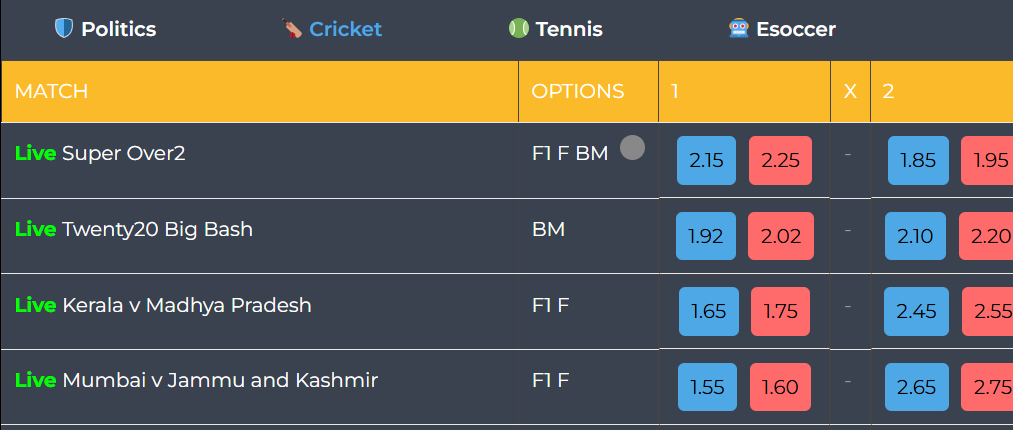
Live in-play markets are cricket-related markets that become available or change while a match is being played. Instead of considering only the expected winner before the toss, users can follow different match situations as they develop.
For example, during a T20 match, the available markets may relate to:
- Match winner
- Next over performance
- Total runs in an innings
- Individual player performance
- Next wicket
- Over-by-over scoring
- Session or innings outcomes
The availability of these markets depends on the match, platform coverage, and market conditions.
The most important difference between pre-match and live markets is timing. Pre-match markets are based on information available before the first ball, whereas live markets continuously respond to events taking place on the field.
2. How Sky Exchange Live Cricket Markets Work
Sky Exchange users interested in live cricket can explore the cricket section and review the markets available for a particular fixture.
The general process involves understanding the match, reviewing the displayed market information, and recognising that prices and availability may change throughout the game.
Here is how the experience generally works:
Step 1: Select a cricket match
Start by identifying the fixture you want to follow. Depending on platform coverage, matches may include international cricket, domestic competitions, T20 leagues, and other tournaments.
Step 2: Explore the available markets
Open the selected fixture and review the available options. Different matches can have different market selections depending on the competition and stage of the game.
Step 3: Understand the displayed odds
Odds represent the market’s pricing of a particular outcome. They can change as the match develops and should not be treated as guaranteed probabilities or predictions.
Step 4: Follow live match developments
Keep track of the score, wickets, overs remaining, and other relevant match information. Live market conditions can change quickly following important events.
Step 5: Review market rules
Before participating, understand the applicable settlement rules, suspended-market conditions, and platform terms. Never assume that every market follows identical rules.
3. Popular Types of Live Cricket Markets
Understanding the different market categories helps readers become familiar with live cricket terminology.
Match Winner Market
The match winner market focuses on which team will win the fixture. Before the match, expectations are generally influenced by team strength, recent form, and playing conditions.
During the match, the situation can change significantly. A team losing early wickets may see its position weaken, while a strong partnership can improve its chances.
Over Runs Market
Over runs markets relate to the number of runs scored during a particular over or a specified group of overs.
For example, a T20 team might score 12 runs in one over and only 4 in the next. Such variations demonstrate why individual overs can have a different impact on the overall innings.
Total Innings Runs
This market focuses on the total runs scored by a team during its innings. The expected total can be influenced by the batting lineup, remaining wickets, overs available, pitch conditions, and scoring rate.
A team scoring quickly during the powerplay may create a different match situation from one that begins cautiously.
Player Performance Markets
Some cricket fixtures may feature markets connected with individual players. These can include runs scored by a batter, wickets taken by a bowler, or other player-related performances.
Player availability, batting position, bowling allocation, and match conditions are important considerations when understanding these markets.
Next Wicket Market
The next wicket market focuses on which team will lose its next wicket or when the next dismissal might occur, depending on the market format.
Batting partnerships, bowling changes, field placements, and the condition of the pitch can all influence the situation.
It is important to remember that none of these factors guarantees a particular result.
4. Important Factors to Understand Before Following Live Markets
Live cricket requires attention to more than just the scoreboard. Several match-related elements can influence how the game develops.
Current Run Rate and Required Run Rate
The current run rate shows how quickly a batting team is scoring. The required run rate indicates the scoring speed needed to achieve a target within the remaining overs.
For example, if a team requires 60 runs from 30 balls, its required run rate is 12 runs per over.
This information helps explain the pressure on the batting side, although the number of wickets remaining and the players at the crease also matter.
Wickets in Hand
A team with eight wickets remaining has more batting resources available than a team with only two wickets remaining.
However, wickets alone do not tell the complete story. The quality of the remaining batters, their current form, and their ability to handle pressure are equally important.
Pitch and Weather Conditions
Pitch conditions can influence batting and bowling performances. Some surfaces offer assistance to fast bowlers, while others provide more opportunities for spin.
Weather can also interrupt play, reduce the number of available overs, or affect the official result.
Powerplay Performance
The powerplay is an important phase in limited-overs cricket. Fielding restrictions create opportunities for batters to score boundaries, although early wickets can change the direction of an innings.
Understanding the powerplay provides useful context when following T20 and ODI matches.
Bowling Changes
Captains regularly adjust their bowling combinations according to match conditions. A change of bowler can influence scoring patterns, particularly when a specialist bowler enters during a difficult phase.
However, one successful over should not automatically be treated as evidence that the entire match has changed.
5. Understanding Odds Movement in Live Cricket
One of the defining features of live markets is changing odds.
Odds can move after important match events, including:
- A batter hitting consecutive boundaries.
- A wicket falling during a partnership.
- A bowler delivering a successful over.
- A team completing a strong powerplay.
- A batting side losing momentum.
- Rain interruptions or changes to the playing conditions.
Consider a hypothetical T20 match in which Team A needs 45 runs from the final four overs.
If two experienced batters are at the crease, the market may reflect one set of expectations. If a wicket falls immediately afterwards, the displayed odds may change.
This is because market pricing responds to updated information and the perceived likelihood of different outcomes.
An important point: Shorter odds do not mean a guaranteed result, and higher odds do not automatically represent better value. Market prices can change rapidly, and users should avoid making decisions based solely on sudden movements.
6. Common Mistakes to Avoid in Live Cricket Markets
Newcomers sometimes make avoidable mistakes because they focus too heavily on individual deliveries rather than the wider match situation.
Here are some common mistakes worth understanding.
Following emotions instead of match information: Supporting a particular team can create bias. It is important to separate personal loyalty from objective match analysis.
Ignoring the number of wickets remaining: Runs and overs are important, but wickets can significantly influence a team’s ability to finish an innings.
Reacting to every boundary: A single boundary does not necessarily change the overall direction of a match. The wider situation matters.
Ignoring market rules: Different markets can have different settlement conditions. Always read the relevant rules before participating.
Chasing previous losses: Trying to recover losses through additional participation can lead to poor financial decisions. Taking a break is a better approach.
Using delayed information: Live scorecards, television coverage, and online commentary may not update simultaneously. A delay can make the information you are viewing different from the information reflected in a live market.
Read Also: How to Check a Card Game Result | Best Sky Exchange Promotions for Existing Customers in 2026 | Ranji Trophy Final 2026 | Sky Exchange XYZ – Complete Informational Guide
7. Why Market Rules and Live Updates Matter
Market rules are an essential part of understanding any live cricket platform. Users should never assume that all markets are settled in the same way.
For example, a rain-affected ODI or T20 match may have a revised target or a reduced number of overs. An abandoned fixture can also have different settlement implications depending on the specific market.
Technical interruptions, suspended markets, incorrect score information, and delayed updates are additional situations worth understanding.
Before participating through SkyExchange, users should review the applicable terms, market-specific information, and settlement conditions.
A good understanding of the rules helps avoid confusion when a match does not follow its original schedule.
8. Responsible Participation in Live Cricket Markets
Live cricket markets can move quickly, which makes responsible participation especially important. The excitement of following a close match should never lead to decisions that negatively affect personal finances.
Consider these practical guidelines:
- Set a fixed budget: Decide how much you can comfortably afford to spend before participating.
- Set time limits: Avoid spending excessive time following live markets.
- Never chase losses: Previous losses should not influence future financial decisions.
- Avoid impulsive decisions: Do not react emotionally to wickets, boundaries, or changing odds.
- Understand the risks: No cricket analysis or prediction can guarantee an outcome.
- Take regular breaks: Step away whenever participation becomes stressful or difficult to control.
Users should also check the laws and eligibility requirements applicable to their location. Online betting is restricted or prohibited in certain jurisdictions, and platform availability does not establish legal permission.
9. Exploring Cricket on Sky Exchange
For cricket enthusiasts interested in understanding online cricket markets, Sky Exchange provides a dedicated cricket section where users can explore the available platform features.
The website is designed around sports-related content and cricket-focused experiences. Users can visit the cricket section to learn more about the platform and its available features.
Useful pages include:
- Sky Exchange Official Website
- Sky Exchange Cricket
- Sky Exchange Login
- Sky Exchange Responsible Gaming Policy
Before using any service, review its terms and conditions, eligibility requirements, and responsible participation guidelines.
Conclusion
Live in-play cricket markets introduce a different way of following the game because the available markets and displayed odds can change as the match progresses. From match winner and total innings runs to over runs and player performance, different market categories reflect different aspects of cricket.
Understanding run rates, wickets in hand, pitch conditions, bowling changes, and match situations can help readers develop a better understanding of live cricket markets.
For anyone exploring Sky Exchange Cricket Betting Live In-Play Markets, knowledge should always come before participation. Understanding market rules, recognising the limitations of live information, and maintaining responsible financial boundaries are essential.
Cricket remains an unpredictable sport. Even the strongest teams and most experienced players cannot guarantee a particular result. Enjoy following the game, stay informed, and make responsible decisions.
Disclaimer: This article is for informational and educational purposes only. It does not guarantee betting outcomes or encourage participation in activities prohibited by applicable local laws. Users should understand the risks and follow responsible gaming practices.
The post A Practical Guide to Sky Exchange Cricket Betting Live In-Play Markets appeared first on Sky Exchange.
]]>The post How to Check a Card Game Result When the Internet Disconnects on SkyExchange appeared first on Sky Exchange.
]]>That moment is stressful, but it is also very common, and it has a calm answer. This guide explains how to check game result after disconnect on SkyExchange, what usually happens to your bet while you are offline, where to look in your account, and what to do if the numbers still do not add up. It applies to the live card games most Indian players use: Teen Patti, Andar Bahar, Baccarat, Blackjack and Dragon Tiger.
One note before we start: menu names can differ between the website and the app, so we describe what to look for rather than promise a specific button. SkyExchange support can confirm details for your own account.
What Happens to Your Bet The First Step in How to Check Game Result After Disconnect
Your connection and the game are two separate things. On a live table the dealer, the cards and the round all run on the platform’s side, and your phone is only a window onto it. When the window goes dark, the round does not pause.
On most live card tables that works out to three situations:
- A bet you confirmed before the drop normally stays in play. The round finishes, the result is recorded, and any win or loss is applied to your wallet.
- A bet you never confirmed was not placed. If your screen froze while you were still choosing a stake, nothing was submitted.
- A hand that needs your decisions may be handled automatically. In Blackjack, for example, a hand left unfinished is usually resolved with a default action. The exact rule belongs to the game and is explained in its info panel and in the terms and conditions.
Your first job is to find out which of those three situations you were in. That is the heart of how to check game result after disconnect, and the next section turns it into steps.
How to Check Game Result After Disconnect Step by Step
Here is how to check game result after disconnect, in the order that works best.
- Pause and do not bet again. Do not jump back to the table while you are unsure. A second bet only makes the record harder to read.
- Get a stable connection first. Switch between Wi-Fi and mobile data, or turn flight mode on for ten seconds and off again. Reloading on a weak signal can freeze again.
- Log back in. Use the official SkyExchange login page or the app. If you are asked for an OTP, enter it yourself. Never share an OTP or password with anyone, including someone who says they are from support.
- Check your wallet balance. Compare it with what you had before the round. A change in either direction usually means the round has settled. A balance that dropped by your stake and has not moved since may mean the bet is still waiting to settle.
- Open your game or bet history. Look in your account for a section with a name like Game History, Bet History, Account Statement or Transaction History. Find the latest entry for the table you were playing. It should show the game, time, stake and outcome.
- Match the time. Compare the entry’s time with when you remember the disconnect. An entry at that time is your answer.
- Take screenshots. Even when the result is clear, screenshot the history entry and your balance as proof.
For most people this sequence of how to check game result after disconnect settles the question in a couple of minutes. If the entry is not there yet, wait ten to fifteen minutes as a rule of thumb before assuming something is wrong, then move to the support steps below.
Where to Look First When You Need to Know How to Check Game Result After Disconnect
Players often check the wrong place first, so know what each part of your account shows.
Wallet balance shows the current state of your money, not why it changed. Game or bet history records the round: game, table, bet and result. Account statement shows money movement such as stakes, winnings and deposits. Open or pending bets, if your account has that view, show bets that have not settled yet, which is different from a bet that never existed.
If your history shows a round reference or ID, screenshot it. It is the fastest way for support to find the exact round.
What Your Wallet Tells You in How to Check Game Result After Disconnect
The balance and the history together usually point to one of a few situations. Treat this table as a guide, not a guarantee, because exact behaviour depends on the game.
| What you see | What it likely means | What to do |
|---|---|---|
| Balance went up and history shows a win | The round settled in your favour | Screenshot it and carry on |
| Balance dropped by your stake and history shows a loss | The round settled as a loss | Screenshot it for your records |
| Balance dropped by your stake, no result yet | The bet may be waiting to settle | Wait, refresh, then contact support if it stays unchanged |
| Balance unchanged and no history entry | The bet was probably never confirmed | Check again, and ask support if you are unsure |
| Balance changed but no matching history entry | The history may be delayed | Screenshot both and contact support |
Whichever row you land on, the rule is the same. Look first, screenshot second, ask third. That order is the practical answer to how to check game result after disconnect without making the situation worse.
Read Also: Asian Games 2026 Final | Harry Kane Wins the 2026 Ballon d’Or | India vs New Zealand 5th T20I 2026 | India vs England T20 World Cup 2026 Semifinal | Hidden Tricks to Stay Longer in Mines Game | How to Deposit on SkyExchange
How to Check Game Result After Disconnect in Each Card Game
The steps above work for every game, but each card game has its own quirks.
Teen Patti
In Teen Patti, how to check game result after disconnect matters more, because decisions come after you see your cards. If you dropped out before acting, the table may have applied a default for your hand. Your history shows how it ended, and support can review it if the outcome surprises you.
Andar Bahar
For how to check game result after disconnect in Andar Bahar, remember that rounds are very short, so several may have passed by the time you reconnect. Match the time and your bet side (Andar or Bahar) rather than opening the latest round.
Baccarat
After you bet on Player, Banker or Tie you make no further decisions, so how to check game result after disconnect is simplest here. If the bet was confirmed, the result is in your history.
Blackjack
In Blackjack, how to check game result after disconnect needs extra care, because mid-hand decisions (hit, stand, double, split) can change the result most. An unfinished hand is typically resolved by a default action, but details depend on the game. Check the game’s info panel and ask support if the outcome does not match.
Dragon Tiger
One card each, resolved in seconds. By the time you reconnect the round is almost certainly over. Look for the entry that matches your time and your bet on Dragon, Tiger or Tie.
Contacting Support When How to Check Game Result After Disconnect Is Not Enough
Sometimes the history is unclear or the balance does not match. When the steps above do not settle how to check game result after disconnect for your particular case, contact SkyExchange support through WhatsApp or live chat, which are available around the clock. A complete first message gets a faster answer.
Include:
- Your SkyExchange username and the registered mobile number
- The game and table you were playing
- The approximate time of the disconnect, in Indian Standard Time
- Your bet amount and the side or option you chose
- Your balance before and after the round
- Screenshots of your history, statement and balance
- The round reference, if one was shown
Do not send your password or an OTP. Support never needs them. Be wary of anyone who offers to “recover” a result for a fee.
Keep your message calm and specific. Outcomes depend on the game rules and the platform’s records, so support may confirm a result is correct even when it is not the one you hoped for.
Mistakes to Avoid in How to Check Game Result After Disconnect
The biggest mistake with how to check game result after disconnect is acting before you know what happened. A few specific traps:
- Betting again to “make up” for a possible loss. You do not yet know whether there was a loss. Chasing a result you have not confirmed is the fastest way to turn one confusing round into several expensive ones.
- Depositing more because the balance looks low. A balance that has dropped by your stake may simply be waiting to settle. Check first.
- Trusting strangers who offer help. Only official support should be involved in checking or correcting your account.
Stop It Before It Starts — Fewer Reasons to Learn How to Check Game Result After Disconnect
You cannot control every network drop, but you can reduce how often it happens at a bad moment.
- Use a stable connection. Strong home Wi-Fi or a good mobile signal beats public Wi-Fi in crowded places.
- Close other apps. Streaming and downloads running in the background compete for the same bandwidth.
- Ease off battery saving while you play. Some phones restrict background connections.
- Keep the app updated. Download the SkyExchange app from the official site and update it when a new version appears.
- Match your stake to your connection. If your signal is weak, play smaller or wait until it improves.
If you need an account first, you can create your SkyExchange ID in a few minutes with your mobile number and OTP.
A Calmer Way to Think About Disconnects
Your job after a drop is only to read the record of the round carefully. Reconnect, log in, check your wallet, open your history, screenshot what you find and ask support when something does not match. That short routine is all you need to remember about how to check game result after disconnect.
A disconnect is also a good moment for a short break. If frustration is building, step away before you bet again. Treat card games as entertainment, set a budget before you play, and stop when you reach it.
Frequently Asked Questions
Does my bet still count if my internet drops?
Usually yes, if it was confirmed before the drop. A bet that was never confirmed was not placed. Your history shows which applies.
How long should I wait for a result to appear?
Live rounds normally settle quickly. If nothing appears after ten to fifteen minutes, take screenshots and contact support.
Where do I find my game history?
Look in your account for a section named something like Game History, Bet History, Account Statement or Transaction History. Labels can differ between the website and the app.
Can I get a refund for a round I missed?
That depends on the game rules and what the records show. Support reviews the round; nothing is guaranteed.
What if my balance looks wrong after reconnecting?
Screenshot the balance and your history, then contact support with the time, game and bet details.
Is there a quick summary of how to check game result after disconnect?
Reconnect on a stable network, log in, check your wallet, open your game history, match the time, take screenshots, and contact support only if something does not line up.
This article is for informational purposes only and does not describe guaranteed platform behaviour. Rules vary by game, and SkyExchange support can confirm how a specific round was handled. Please play responsibly. 18+ only. Users are responsible for checking the laws that apply in their own jurisdiction.
The post How to Check a Card Game Result When the Internet Disconnects on SkyExchange appeared first on Sky Exchange.
]]>The post India vs New Zealand 5th T20I 2026 — Series Finale Preview, Squads and What to Watch in Hamilton appeared first on Sky Exchange.
]]>If you follow cricket through SkyExchange, a series finale like this tends to behave differently from a decider. Teams rotate, odds can look odd, and the toss matters in ways the scorecard doesn’t capture. This preview covers how the series got here, what to expect at Seddon Park, the squads, the match-ups worth your attention and our read on the India vs New Zealand 5th T20I.
India vs New Zealand 5th T20I — Match Details at a Glance
| Detail | Info |
|---|---|
| Match | New Zealand vs India, 5th T20I |
| Series | India tour of New Zealand 2026, five T20Is |
| Date | Sunday, 1 November 2026 |
| Start | 12:30 PM IST (about 8:00 PM local), toss roughly half an hour earlier |
| Venue | Seddon Park, Hamilton |
| Series score | India lead 3-0 |
| Captains | Mitchell Santner (NZ), Shreyas Iyer (India) |
| Live coverage | SkyExchange |
Broadcast listings differ between sources, with some naming JioHotstar and others Sony and DD Sports, so check your own app or TV guide before the toss.
How the India vs New Zealand 5th T20I Became a Series Finale
Three matches, three Indian wins, and each one was won differently.
1st T20I, Christchurch (22 October). New Zealand posted 225 for 4, a total that usually wins in this format. India chased it down with two balls to spare, finishing on 230 for 6. It was tense for most of the chase, and the margin of four wickets tells you how close it was.
2nd T20I, Christchurch (24 October). Even tighter. New Zealand made 180 for 5, and India got there on 181 for 6 with a single ball left. If one delivery had gone differently, this series would look completely different.
3rd T20I, Wellington (27 October). This was the one-sided match. New Zealand made 198 for 3, with Daryl Mitchell unbeaten on 89 and Finn Allen adding 40 after the pair hit eight sixes between them in the first eight overs. India still chased it in 13.2 overs. Abhishek Sharma made 113 and Vaibhav Sooryavanshi 45, and the two put on 118 for no loss in the powerplay, the highest powerplay score in men’s T20Is. India won by six wickets with 40 balls to spare and sealed the series with two games left.
The pattern is hard to miss. New Zealand have scored 225, 180 and 198 batting first and lost every time. That is not a batting problem. It is a bowling and fielding problem, and it is why the India vs New Zealand 5th T20I is more about New Zealand fixing something than India proving anything.
The fourth T20I is at Eden Park in Auckland on Friday, 30 October. India have won all three T20Is they have played at that ground, so check the latest score before you finalise any view on the finale.
Seddon Park — What to Expect in the India vs New Zealand 5th T20I
Seddon Park is a round, well-grassed ground. The India vs New Zealand 5th T20I will be its first men’s T20I since New Zealand played Pakistan there in January 2024, so there is very little recent T20I data from this surface to lean on.
No pitch report had been published at the time of writing, so treat anything you read before the toss as informed guessing. What we do know is that the series has so far produced big totals in Christchurch and Wellington, and nothing suggests Hamilton will behave very differently. The better indicator will be the toss: India chased in all three matches and won all three, so expect any captain who wins the toss to bowl first and take on the target.
India in the India vs New Zealand 5th T20I — A Settled Top Order, Questions Beneath It
India’s squad for the T20I leg is Shreyas Iyer (captain), Tilak Varma (vice-captain), Sanju Samson (wicketkeeper), Ishan Kishan (wicketkeeper), Abhishek Sharma, Vaibhav Sooryavanshi, Shivam Dube, Nitish Kumar Reddy, Axar Patel, Naman Dhir, Prince Yadav, Mayank Yadav, Arshdeep Singh, Bhuvneshwar Kumar, Varun Chakaravarthy and Kuldeep Yadav.
For the 3rd T20I they went with Abhishek, Samson, Sooryavanshi, Iyer, Tilak, Dhir, Reddy, Axar, Bhuvneshwar, Prince Yadav and Arshdeep.
The interesting part of the India vs New Zealand 5th T20I is who comes in. With the series won, India have a squad full of players who have not had a game yet. Ishan Kishan, Shivam Dube, Kuldeep Yadav, Varun Chakaravarthy and Mayank Yadav are all available and unused in that Wellington XI. Expect at least a couple of changes, and expect the wicketkeeper and spin-bowling slots to be the most likely ones to rotate. We are speculating here, since India have not named a team, but the incentive to give everyone a game before the ODIs is strong.
The openers are the story. Abhishek and Sooryavanshi have turned the first six overs into a different sport.
New Zealand in the India vs New Zealand 5th T20I — Runs on the Board, Wins Missing
Mitchell Santner’s side is a 16-man group: Finn Allen, Michael Bracewell, Mark Chapman, Devon Conway, Jacob Duffy, Lockie Ferguson, Zak Foulkes, Matt Henry, Bevon Jacobs, Kyle Jamieson, Adam Milne, Daryl Mitchell, Glenn Phillips, Tim Seifert and Nathan Smith, plus Santner himself.
The batting has delivered. Mitchell’s 89 not out in Wellington was one of the best innings of the series, and Allen has been the kind of opener who can score 40 off 20 balls and change the first eight overs entirely. In Wellington they were 88 for 1 at that stage, which should have been a platform for 220 or more. They finished on 198.
That is the difference between what New Zealand have been doing and what they need to do. Their middle and death overs have lost momentum, and their bowlers have had no answer to India’s powerplay. Even if they bat first and reach 200, the target has not been enough. To win the India vs New Zealand 5th T20I they probably need to do two things: take a wicket in the first three overs, and keep India’s openers under 60 for the powerplay. That has not happened yet in this series.
They won their first ODI series in India in January, and the ODIs on this tour are the next real test. The India vs New Zealand 5th T20I is a chance to find the bowling combination and field placements that work.
Key Battles in the India vs New Zealand 5th T20I
Abhishek Sharma and Vaibhav Sooryavanshi vs the new ball. New Zealand’s best chance of changing the shape of the match is in the first three overs. Kyle Jamieson took two wickets in Wellington, and Lockie Ferguson, Matt Henry and Adam Milne are all options for the new ball. If they can force even one early mistake from the openers, the powerplay score drops by 30 runs.
Daryl Mitchell vs India’s spinners. Mitchell has been New Zealand’s most reliable batter. India have Axar, Kuldeep and Varun available, and the spinner selected will dictate how Mitchell approaches the middle overs. If he can play spin into the leg side the way he did against pace in Wellington, the total goes up quickly.
Finn Allen vs Arshdeep Singh and Bhuvneshwar Kumar. Allen’s early hitting has been the biggest source of New Zealand’s momentum. The test for India’s swing and seam bowlers is whether they can pull the length back in the first two overs, when he looks to attack.
India’s depth vs New Zealand’s death overs. If the chase goes beyond the first ten overs, players like Naman Dhir, Nitish Kumar Reddy and Shivam Dube become the match-winners. New Zealand have conceded runs at the back end all series, so their last five overs will tell us a lot.
India vs New Zealand 5th T20I Prediction — India Favoured, But Not by a Mile
India are the clear favourites. They have won 22 of the T20Is the two sides have played against New Zealand’s 11, according to pre-match listings. They have beaten New Zealand 4-1 in a T20I series at home earlier this year, won the T20 World Cup final by 96 runs in March, and have now won all three matches here.
But there is a reason to be careful with the India vs New Zealand 5th T20I. Series finales with a settled result are often different. India are likely to rotate, and a changed XI is a less cohesive one. New Zealand, meanwhile, have scored big totals and fought hard in the first two matches. They need only one good bowling performance to make this a real contest.
Our read on the India vs New Zealand 5th T20I:
- Likely winner: India, with New Zealand’s best chance coming if they win the toss and bat first.
- Toss: Expect the captain winning it to bowl first.
- Player to watch: Abhishek Sharma for India and Daryl Mitchell for New Zealand.
- Biggest swing factor: whether New Zealand take early wickets.
What Comes After the India vs New Zealand 5th T20I — ODIs and Tests
The five-match ODI series starts on 4 November, and it is a very different contest. Shubman Gill will captain India in the first three ODIs and in the Tests, with Shreyas Iyer taking over as ODI captain for the last two. After the ODIs there are two Tests as part of the 2025-27 World Test Championship cycle, with the second Test finishing on 1 December.
Following the India vs New Zealand 5th T20I on SkyExchange
If you want to follow the match on SkyExchange, the steps are simple:
- Create your SkyExchange ID with your mobile number and OTP.
- Add funds with UPI (Google Pay, PhonePe or Paytm). The minimum deposit is ₹100.
- Log in to SkyExchange and open the cricket section before the toss.
- Markets usually include match winner, top batter and session runs, depending on liquidity.
- Download the SkyExchange app for match-day access on your phone.
A match with a settled series result is a good time to be disciplined. Set a budget before you begin, avoid chasing losses, and treat it as entertainment rather than income.
Frequently Asked Questions
When is the India vs New Zealand 5th T20I? Sunday, 1 November 2026, with the match starting at 12:30 PM IST at Seddon Park in Hamilton.
What is the series score before the India vs New Zealand 5th T20I? India lead 3-0 after the first three matches, so the series is already decided. The fourth T20I is at Eden Park in Auckland on 30 October.
Where is the India vs New Zealand 5th T20I played? At Seddon Park in Hamilton, New Zealand.
Who are the captains? Shreyas Iyer leads India and Mitchell Santner leads New Zealand.
Has India chased in every match this series? Yes. New Zealand batted first in all three matches and India chased successfully each time.
What happens after the T20I series? A five-match ODI series starts on 4 November, followed by two Tests, with the second ending on 1 December.
Where can I follow the match live? Broadcast listings vary between sources, so check your app or TV guide. You can also follow it through SkyExchange after you log in.
This article is for informational purposes only. Please engage with any online platform responsibly. 18+ only. Users are responsible for checking the laws that apply in their own jurisdiction.
The post India vs New Zealand 5th T20I 2026 — Series Finale Preview, Squads and What to Watch in Hamilton appeared first on Sky Exchange.
]]>The post Asian Games 2026 Final: India Beat Pakistan to Win Gold appeared first on Sky Exchange.
]]>IN the Sky exchange analysis, Abhishek Sharma provided India with an explosive start, Tilak Varma produced a crucial unbeaten half-century, and Shivam Dube contributed with both bat and ball as India held their nerve in the closing stages. For Pakistan, Hasan Nawaz produced a remarkable 96 from 51 balls, but his effort was ultimately not enough to take his team to the gold medal.
For cricket followers searching for Asian Games 2026 cricket results, India vs Pakistan Asian Games 2026, Asian Games cricket final and T20 cricket updates, the final became one of the standout matches of the tournament.
India Win Asian Games 2026 Cricket Gold
India entered the final as the defending Asian Games men’s cricket champions and completed their campaign with another gold medal.
After winning the toss, India captain Shreyas Iyer elected to bat first. The decision immediately paid off as India’s openers attacked the Pakistan bowling attack during the powerplay.
India raced to 50 in only 3.2 overs before Abhishek Sharma continued his aggressive approach. The left-handed opener eventually scored 61 runs from just 28 deliveries, providing the foundation for a huge Indian total.
His innings included three fours and seven sixes and demonstrated the importance of a fast start in T20 cricket.
Abhishek Sharma Sets the Platform
Abhishek Sharma was one of the biggest reasons India were able to reach such a challenging total.
Pakistan struggled to contain India’s attacking approach during the opening overs. Their bowlers repeatedly missed their lengths, allowing Abhishek to take advantage of deliveries that offered scoring opportunities.
He brought up his half-century from just 20 balls before eventually being dismissed by Arafat Minhas.
Although India lost wickets during the middle overs, Abhishek’s quick 61 had already given the team significant momentum.
For fans following Sky Exchange cricket and international T20 matches, the innings demonstrated how important powerplay scoring can be when assessing the development of a short-format game.
Tilak Varma and Shivam Dube Finish Strong
India appeared to lose some momentum during the middle portion of the innings.
Pakistan’s bowlers tightened their lines and India went through a period of 34 deliveries without a boundary. The match changed again when Tilak Varma broke the boundary drought.
Tilak finished the innings in spectacular fashion.
He scored an unbeaten 51 from only 22 balls and attacked Pakistan’s bowlers during the closing overs. Shivam Dube also played an important cameo, scoring 27 runs.
The pair added a crucial sixth-wicket partnership that helped India move beyond the 200-run mark.
India eventually finished on:
India: 211/6 in 20 overs
- Abhishek Sharma – 61 off 28
- Tilak Varma – 51* off 22
- Shivam Dube – 27
- Arafat Minhas – 2/25
- Ahmed Daniyal – 2 wickets
The total became the highest match total of the Asian Games men’s cricket competition.
Pakistan Begin the Chase Under Pressure
Pakistan required 212 runs to win the Asian Games 2026 gold medal.
The chase did not begin according to plan.
India’s bowlers created early pressure and Pakistan reached only 39/3 during the powerplay. Axar Patel and Washington Sundar played important roles during the early phase, while Jasprit Bumrah’s pace and bounce made scoring difficult.
At that stage, India’s position appeared strong.
However, Pakistan were not ready to give up.
Hasan Nawaz Keeps Pakistan Alive
Hasan Nawaz produced one of the outstanding individual performances of the Asian Games final.
After Pakistan lost early wickets, Nawaz joined Saim Ayub and began rebuilding the innings. The pair put together an 87-run partnership that brought Pakistan back into contention.
Nawaz continued attacking as the required run rate increased.
He reached his half-century from 28 balls and continued scoring boundaries deep into the innings. His final score was an impressive 96 from 51 deliveries, including five fours and seven sixes.
Saim Ayub contributed 29 from 22 balls before Shivam Dube dismissed him.
Pakistan still needed 68 runs from the final four overs, leaving India with very little room for error.
Read Also: India vs Pakistan Asia cup Final | India vs Pakistan | India vs pakistan
India Hold Their Nerve in the Final Overs
The closing stages produced the tension expected from an India-Pakistan final.
Pakistan continued to attack, but India’s bowlers managed to keep the required rate under pressure.
Washington Sundar delivered a crucial 18th over, dismissing Abdul Samad and conceding only eight runs apart from a final-ball six.
Jasprit Bumrah then bowled the penultimate over.
With Pakistan requiring 33 runs from the final six deliveries, Shivam Dube was handed the ball for the last over.
Pakistan added a boundary and a wide early in the over, but Dube responded with a yorker that effectively ended Pakistan’s hopes of completing the chase.
Hasan Nawaz was eventually dismissed from the final delivery.
Pakistan finished on:
Pakistan: 192/6 in 20 overs
- Hasan Nawaz – 96 off 51
- Saim Ayub – 29 off 22
- Maaz Sadaqat – 23
- Axar Patel – 2/29
- Washington Sundar – 2/29
- Shivam Dube – 2/33
India won by 19 runs.
India vs Pakistan Asian Games 2026 Final: Match Summary
| Team | Score | Result |
|---|---|---|
| India | 211/6 | Won |
| Pakistan | 192/6 | Lost |
| Winning margin | 19 runs | India |
| Format | T20 | Gold Medal Match |
| Venue | Korogi Sports Park, Nisshin | Japan |
The result gave India their second consecutive gold medal in the men’s cricket competition at the Asian Games.
Pakistan finished with the silver medal.
Sri Lanka Take the Bronze Medal
The bronze-medal match was also played on October 3, with Sri Lanka facing Bangladesh.
Sri Lanka scored 165/9 before restricting Bangladesh to 102 all out, winning by 63 runs.
All-rounder Tharindu Ratnayake played a major role, scoring 65 from 32 deliveries and later contributing with the ball.
The result meant Sri Lanka claimed the bronze medal, while Bangladesh finished fourth.
Asian Games 2026 Men’s Cricket: Final Standings
The medal positions were:
Gold – India
Silver – Pakistan
Bronze – Sri Lanka
Fourth – Bangladesh
India therefore completed another successful Asian Games men’s cricket campaign.
Asian Games Cricket 2026: Key Performances
Several players made a major impact throughout the tournament.
Abhishek Sharma
Abhishek’s 61 from 28 balls in the final gave India the perfect start. His power-hitting during the opening overs put Pakistan under immediate pressure.
Tilak Varma
Tilak Varma finished unbeaten on 51 from 22 deliveries. His late acceleration helped India cross the 200-run mark.
Shivam Dube
Dube contributed 27 runs and later claimed two wickets, including the final wicket of Hasan Nawaz.
Hasan Nawaz
Pakistan’s Hasan Nawaz delivered the highest individual score of the final, making 96 from 51 balls. His innings kept Pakistan’s chase alive until the final delivery.
Washington Sundar
Washington played an important role with the ball, taking two wickets and bowling a critical 18th over during Pakistan’s chase.
What the Asian Games 2026 Final Means for T20 Cricket
The India-Pakistan final showed how quickly momentum can change in T20 cricket.
India’s fast start created the foundation for 211 runs, while Pakistan’s middle-order recovery brought the chase back into the contest. The final overs ultimately decided the result.
For readers following T20 cricket 2026, the match also provides several useful areas to examine, including:
- Powerplay scoring
- Middle-over partnerships
- Death-over batting
- Bowling changes
- Required run rate
- Wicket-taking opportunities
- Fielding pressure
- Batting depth
These elements are particularly important when following live T20 matches and understanding how match situations change from one over to the next.
Following Cricket on Sky Exchange
The Asian Games final adds another major international T20 match to the 2026 cricket calendar.
Readers searching for Sky Exchange cricket, Sky Exchange live cricket, Sky Exchange ID, Sky Exchange login, Sky Exchange app, Sky Exchange VIP and skyexchange can follow major cricket competitions alongside tournament schedules, results and match information.
For anyone researching cricket markets on Sky Exchange, it is useful to study confirmed team news, playing XIs, recent performances, pitch conditions and match statistics before making any decisions.
Users should also check the laws and regulations applicable in their location before accessing online gaming or wagering services.
Sky Exchange Cricket Keywords for Asian Games 2026
This Asian Games cricket story is relevant to searches such as:
- Asian Games 2026 cricket
- Asian Games 2026 men’s cricket
- Asian Games cricket final
- Asian Games cricket results
- India vs Pakistan Asian Games 2026
- India Pakistan cricket final
- Asian Games 2026 gold medal
- T20 cricket 2026
- India cricket news
- Pakistan cricket news
- Sky Exchange cricket
- Sky Exchange live cricket
- Sky Exchange ID
- Sky Exchange login
- Sky Exchange app
- Sky Exchange VIP
- Sky Exchange sports
- skyexchange
Final Thoughts
India’s 19-run victory over Pakistan completed a memorable Asian Games 2026 men’s cricket tournament.
Abhishek Sharma’s explosive 61 established India’s platform, while Tilak Varma’s unbeaten 51 and Shivam Dube’s late contribution pushed India to 211/6. Pakistan responded strongly through Hasan Nawaz, whose 96 from 51 balls kept the contest alive until the final delivery.
However, India’s bowling attack managed the decisive moments better and restricted Pakistan to 192/6.
With this victory, India retained the Asian Games men’s cricket gold medal, Pakistan collected silver and Sri Lanka secured bronze.
For cricket fans following Asian Games 2026, India vs Pakistan, T20 cricket, Sky Exchange cricket and the latest international cricket results, the final will remain one of the defining matches of the tournament.
The post Asian Games 2026 Final: India Beat Pakistan to Win Gold appeared first on Sky Exchange.
]]>The post Asian Games 2026 Men’s Cricket: Schedule, Teams, Results & Final Preview appeared first on Sky Exchange.
]]>For fans following cricket markets and match information on Sky Exchange, the tournament provides another major international cricket event to track alongside other T20 and international competitions.
The men’s cricket competition is being played in T20 format, with India, Pakistan, Bangladesh and Sri Lanka seeded directly into the quarterfinals. Afghanistan, Japan, Nepal, Hong Kong China, Malaysia and Oman contested the preliminary stage for the remaining knockout positions.
Asian Games 2026 Men’s Cricket Overview
The 20th Asian Games are being held in Aichi-Nagoya, Japan, from September 19 to October 4, 2026. Cricket was officially included in the Games programme in the T20 format for both men and women.
Key Tournament Details
| Detail | Information |
|---|---|
| Tournament | Asian Games 2026 Men’s Cricket |
| Host | Aichi-Nagoya, Japan |
| Format | T20 |
| Men’s Teams | 10 |
| Competition Start | September 24, 2026 |
| Semi-finals | October 1, 2026 |
| Bronze Medal Match | October 3, 2026 |
| Gold Medal Match | October 3, 2026 |
| Defending Champions | India |
| Main Venue | Korogi Athletic Park, Nisshin |
The competition is being conducted as part of the wider Aichi-Nagoya 2026 Asian Games, with the cricket matches taking place in Aichi Prefecture.
Asian Games 2026 Men’s Cricket Teams
Ten teams are participating in the men’s competition.
Directly Seeded Teams
Four teams received direct entry into the quarterfinals:
- India
- Pakistan
- Bangladesh
- Sri Lanka
India entered the tournament as the defending men’s Asian Games cricket champions after winning gold at the 2022 Hangzhou Games.
Preliminary Round Teams
The other six teams were divided into two groups:
Group A
- Afghanistan
- Japan
- Nepal
Group B
- Hong Kong China
- Malaysia
- Oman
The top two teams from each preliminary group progressed to the quarterfinal stage.
Asian Games 2026 Cricket Schedule
The preliminary round began on September 24, followed by the quarterfinals, semifinals and medal matches.
Preliminary Round
| Date | Match |
|---|---|
| September 24 | Afghanistan vs Japan |
| September 24 | Hong Kong China vs Malaysia |
| September 25 | Hong Kong China vs Oman |
| September 25 | Afghanistan vs Nepal |
| September 26 | Japan vs Nepal |
| September 26 | Malaysia vs Oman |
The preliminary matches determined the four teams joining India, Pakistan, Bangladesh and Sri Lanka in the quarterfinals.
Quarterfinal Stage
The quarterfinals were scheduled for September 28 and 29. However, persistent rain affected the knockout schedule.
The quarterfinal fixtures involving Sri Lanka vs Nepal and Bangladesh vs Malaysia were abandoned without a ball being bowled. Sri Lanka and Bangladesh advanced based on their higher seeding. Reuters reported that the weather conditions at Korogi Sports Park made play impossible.
This illustrates an important feature of short-format cricket tournaments: weather can have a major influence when there is limited time available to complete knockout matches.
Asian Games 2026 Men’s Cricket Semi-Finals
The semifinals were played on October 1.
Pakistan vs Bangladesh
Pakistan defeated Bangladesh by six wickets to reach the men’s cricket final for the first time at the Asian Games.
Bangladesh made 111 for 7 in a match reduced to 13 overs because of a weather delay. Pakistan subsequently reached the target in 11.3 overs.
Pakistan will therefore compete for the men’s cricket gold medal on October 3.
India vs Sri Lanka
India produced a dominant performance against Sri Lanka, winning the second semifinal by 124 runs.
India scored 169 for 7 in 20 overs, with Ishan Kishan making an unbeaten 80 from 46 balls and Vaibhav Sooryavanshi contributing a rapid 38. Sri Lanka were then bowled out for 45 in the 10th over, with Jasprit Bumrah taking two wickets in the opening over.
The result sent the defending champions into another Asian Games men’s cricket final.
Read Also: SkyExchange Master ID Guide | What Are Crash Games | India Beat Afghanistan in 1st T20I | Ranji Trophy Plate 2026-27
India vs Pakistan: Asian Games 2026 Cricket Final
The gold-medal match is scheduled for October 3, 2026, with India facing Pakistan.
This will be Pakistan’s first appearance in an Asian Games men’s cricket final, while India are attempting to defend the gold medal they won at Hangzhou.
The final is therefore one of the major remaining cricket fixtures of the Aichi-Nagoya Asian Games.
The bronze-medal match will also take place on October 3, with Bangladesh facing Sri Lanka.
Why Asian Games Cricket 2026 Is Important
The inclusion of cricket at the Asian Games provides another international T20 platform for players and teams across the continent.
Cricket has previously featured at the Asian Games, making its return to Aichi-Nagoya part of the sport’s wider international development. The Olympic Council of Asia confirmed cricket’s inclusion in 2025, noting the sport’s popularity across Asia and its place in the programme for the Los Angeles 2028 Olympic Games.
For cricket followers, the tournament also creates opportunities to follow:
- Asian Games cricket live scores
- Asian Games cricket results
- India cricket matches
- Pakistan cricket matches
- T20 cricket fixtures
- Asian Games cricket teams
- Cricket semifinal results
- Asian Games cricket final
- India vs Pakistan cricket
- Asian Games 2026 medal matches
Following Asian Games Cricket on Sky Exchange
Sky Exchange users following international cricket can use tournament schedules and verified match information to keep track of upcoming fixtures, completed matches and tournament stages.
For people searching for Sky Exchange cricket, the Asian Games 2026 men’s competition is another international T20 tournament that can be followed alongside other major cricket events.
Related searches include:
- SkyExchange
- Sky Exchange cricket
- Sky Exchange ID
- Sky Exchange login
- Sky Exchange app
- Sky Exchange VIP
- Sky Exchange live cricket
- Sky Exchange cricket betting
- skyexchange
- skyexchange ID
- skyexchange login
- Sky Exchange sports
- Sky Exchange T20 cricket
Users should always check the applicable laws and regulations in their location before accessing or using any online gaming or wagering service.
Asian Games 2026 Cricket and T20 Match Analysis
The short T20 format makes every phase of the Asian Games competition particularly important. Unlike longer formats, teams have fewer overs to recover from a poor start, while powerplay batting, death-over scoring, bowling changes and fielding can quickly influence the result.
For fans researching Sky Exchange cricket matches, useful pre-match information can include:
- Recent team results
- Playing XI announcements
- Pitch and weather conditions
- Toss information
- Batting form
- Bowling combinations
- Head-to-head records
- Tournament standings
- Recent T20 performances
These factors can also help readers better understand how a T20 match develops, regardless of whether they are simply following the cricket or researching available match markets.
Asian Games 2026 Men’s Cricket Final Schedule
The men’s cricket competition is scheduled to conclude on October 3, 2026.
Gold Medal Match
India vs Pakistan
Date: October 3, 2026
The match will determine the men’s cricket gold-medal winner at the Aichi-Nagoya Asian Games.
Bronze Medal Match
Bangladesh vs Sri Lanka
Date: October 3, 2026
The winner will take the bronze medal.
The Olympic Council of Asia has confirmed the India-Pakistan final following India’s semifinal victory over Sri Lanka and Pakistan’s six-wicket win against Bangladesh.
What to Watch in the Asian Games Cricket Final
The final brings together the defending champions and a Pakistan side reaching the Asian Games men’s cricket final for the first time.
India’s semifinal performance included a strong batting display from Ishan Kishan and an early bowling burst led by Jasprit Bumrah. Pakistan, meanwhile, progressed after successfully chasing Bangladesh’s reduced target in a rain-affected semifinal.
The final will therefore provide another high-profile T20 contest between two of Asia’s major cricket teams.
Final Thoughts
The Asian Games 2026 men’s cricket competition has reached its final stage after a tournament affected by both competitive T20 cricket and challenging weather conditions. India, Pakistan, Bangladesh and Sri Lanka entered the knockout stage as seeded teams, while Afghanistan, Japan, Nepal, Hong Kong China, Malaysia and Oman competed for the remaining quarterfinal places.
India and Pakistan will now meet in the Asian Games 2026 men’s cricket final on October 3, while Bangladesh and Sri Lanka will contest the bronze-medal match.
For readers following Asian Games cricket, T20 cricket, India vs Pakistan, Sky Exchange cricket, Sky Exchange ID, Sky Exchange login and skyexchange, the final provides one of the tournament’s most anticipated fixtures.
Source: ESPNcricinfo tournament information and Olympic Council of Asia updates.
The post Asian Games 2026 Men’s Cricket: Schedule, Teams, Results & Final Preview appeared first on Sky Exchange.
]]>The post India Beat Afghanistan in 1st T20I as Women’s Team Crowned Asia Cup Champions appeared first on Sky Exchange.
]]>For cricket fans following every major match, Sky Exchange offers a convenient platform to stay connected with sports and live cricket action. From checking the latest Sky Exchange cricket updates to exploring match-related markets, users can access the platform through their Sky Exchange ID, complete a quick Sky Exchange login, and use the Sky Exchange app for a mobile-friendly experience. As India celebrates victories across both men’s and women’s cricket, Sky Exchange users can continue following match results, player performances, upcoming fixtures, and tournament developments in one place.
India’s men’s side defeated Afghanistan by seven wickets in the first T20I at New Delhi, taking a 1-0 lead in the three-match series. Later, India’s women’s team produced an outstanding performance against Sri Lanka in the Women’s Asia Cup final, winning by 72 runs to become continental champions.

The two results made it a special day for Indian cricket, with both teams delivering impressive performances on the same day.
India Dominate Afghanistan in First T20I
India started their T20I series against Afghanistan in emphatic fashion at the Arun Jaitley Stadium in New Delhi.
After being asked to bat first, Afghanistan recovered from a difficult start to post 156/6 in their 20 overs. The visitors lost early wickets, including Rahmanullah Gurbaz, who was dismissed by Jasprit Bumrah in the opening over.
Afghanistan were reduced to 41/4 during the powerplay before Azmatullah Omarzai and Mohammad Nabi launched a counterattack. Omarzai scored an unbeaten 64 from 44 balls, while Nabi contributed 33 from 27 balls. Their partnership helped Afghanistan reach a competitive 156.
Arshdeep Singh was India’s leading bowler, finishing with impressive figures of 3/19. Bumrah, Axar Patel and Varun Chakravarthy also picked up one wicket each.
Abhishek Sharma Produces a Stunning Knock
India’s chase was dominated by Abhishek Sharma.
The left-handed opener smashed 82 runs from just 32 deliveries, hitting seven sixes and seven fours. His explosive innings gave India complete control of the chase and helped them reach the target with 38 balls remaining.
Ishan Kishan provided valuable support with 42 from 33 balls. After Sanju Samson was dismissed for 10, Kishan helped steady the innings before India accelerated towards victory.
India eventually reached 157/3 in only 13.4 overs. Shreyas Iyer and Tilak Varma completed the chase, giving India a comfortable seven-wicket victory.
The result gives India a 1-0 advantage in the three-match series, with the second T20I scheduled to follow shortly.
India Women Crowned Asia Cup Champions
The celebrations continued in Dubai, where India’s women’s team delivered a dominant performance against Sri Lanka in the Women’s Asia Cup 2026 final.
India won the final by 72 runs after posting an imposing 183/5 before bowling Sri Lanka out for 111. The victory secured India’s eighth Women’s Asia Cup title.
It was a comprehensive performance from India, with the batting unit producing a strong total before the bowlers completed the job.
Shafali Verma and Smriti Mandhana Lead the Batting
India’s innings was built around an excellent opening partnership between Shafali Verma and Smriti Mandhana.
Shafali produced an explosive 68, including the fastest fifty in Women’s Asia Cup history, reaching the landmark in only 24 balls. Mandhana played an equally important role with a composed 59. The pair added 129 runs, giving India an excellent platform.
India finished their 20 overs on 183/5, leaving Sri Lanka with a difficult target.
Read Also: Ranji Trophy Plate 2026-27 | India vs Sri Lanka Series 2026 | 10 Common Betting Mistakes to Avoid | Sky Exchange APK Installation Errors and App Fixes | SkyExchange Master ID Guide
Sree Charani Stars With the Ball
Sri Lanka’s chase never gained momentum as India’s bowling attack applied pressure from the beginning.
Sree Charani was the standout performer, taking four wickets for 20 runs. Deepti Sharma also played an important role with her controlled spell as India’s bowlers dismantled the Sri Lankan batting order.
Sri Lanka were eventually bowled out for 111, giving India a comprehensive 72-run victory.
A Memorable Day for Indian Cricket
The men’s and women’s results together created an exceptional day for Indian cricket.
The men’s team showed its aggressive T20 approach through Abhishek Sharma’s explosive innings and a disciplined bowling effort from Arshdeep Singh. Meanwhile, the women’s team combined powerful batting from Shafali and Mandhana with an excellent spin-bowling display to secure another major international title.
The Women’s Asia Cup victory also underlined India’s strength in women’s cricket, while the men’s win provided an encouraging start to the Afghanistan T20I series.
What These Results Mean for India
India’s double success provides plenty of positives heading into the next phase of the international calendar.
For the men’s team, the immediate focus will be on maintaining momentum against Afghanistan. Abhishek Sharma’s form will be particularly encouraging after his match-winning 82, while India’s bowling attack demonstrated its ability to restrict Afghanistan despite Omarzai and Nabi’s recovery partnership.
For the women’s team, the Asia Cup triumph provides another significant milestone. India’s balanced squad showed that it can win through both batting depth and bowling quality.
The tournament also highlighted the importance of players such as Shafali Verma, Smriti Mandhana, Deepti Sharma and Sree Charani.
Sky Exchange Cricket Fans Have Plenty to Follow
With India’s men’s team leading Afghanistan 1-0 and the women’s team celebrating an Asia Cup championship, Indian cricket fans have plenty to look forward to.
The Afghanistan T20I series will provide further opportunities to assess India’s emerging T20 combinations, while the women’s Asia Cup success gives Indian fans another major international title to celebrate.
For cricket followers looking at match schedules, team performances, player form and upcoming fixtures, these matches provide plenty of talking points.
Sky Exchange readers can continue following the latest cricket news, match previews, score updates and tournament developments as India’s international calendar moves forward.
Final Thoughts
September 13, 2026, will be remembered as a special day for Indian cricket.
India’s men’s team opened its T20I series against Afghanistan with a commanding seven-wicket victory, powered by Abhishek Sharma’s breathtaking 82 from 32 balls.
On the same day, India’s women’s team completed a dominant Women’s Asia Cup campaign by defeating Sri Lanka by 72 runs in Dubai. Shafali Verma and Smriti Mandhana provided the batting foundation, while Sree Charani led the bowling attack with four wickets.
Two teams, two major victories and one unforgettable day for Indian cricket.
The post India Beat Afghanistan in 1st T20I as Women’s Team Crowned Asia Cup Champions appeared first on Sky Exchange.
]]>The post Ranji Trophy Plate 2026-27: Everything You Need to Know Before Betting on Sky Exchange appeared first on Sky Exchange.
]]>Understanding the Ranji Trophy Plate Group
The Plate Group sits below the four Elite groups in the Ranji Trophy structure and typically features the North Eastern states and smaller cricketing associations competing for a place among India’s cricketing elite. The format rewards consistency and depth, with teams playing a round-robin league before the top finishers progress to knockout stages.
Historically, the Plate Group has served as a proving ground for teams like Sikkim, Nagaland, Mizoram, Manipur, Meghalaya, and Arunachal Pradesh, all of whom have used strong Plate campaigns to push for promotion in recent seasons. The winner of the Plate Group earns promotion to the Elite category for the following season, making every match count in the race for advancement.
Key Dates for the 2026-27 Season
The 2026-27 domestic cricket calendar kicks off with the Duleep Trophy in August, followed by the Irani Cup in early October, before the Ranji Trophy itself begins on October 11. This season introduces a split two-phase format designed to protect players from harsh winter conditions in northern India, with the first phase running until early November and the second phase resuming in mid-January through the knockout rounds.
For Plate Group followers, this means an early start to league fixtures in October, followed by a break during the white-ball domestic season, before action resumes in the new year as teams push for a place in the knockout stages.
Teams to Watch in the Plate Group
The Plate Group continues to showcase competitive cricket from India’s North Eastern states and other developing cricketing regions. Teams such as Manipur, Mizoram, Sikkim, Nagaland, Meghalaya, and Arunachal Pradesh typically form the core of this group, each bringing distinct strengths shaped by their playing conditions and squad depth.
Nagaland and Sikkim have historically punched above their weight in recent Plate campaigns, often finishing near the top of the table and pushing for promotion. Meanwhile, teams like Mizoram and Manipur have shown flashes of quality that make them dangerous floaters capable of upsetting the established order on their day.
Why the Plate Group Matters for Bettors
While the Elite groups often attract more mainstream attention, the Plate Group offers unique value for bettors who take the time to study team form and player performances closely. Markets here can carry attractive odds due to less predictable outcomes, especially in matches between closely matched sides where home conditions and squad availability play a significant role.
Before diving into Plate Group betting, make sure you’ve completed your registration and received your Sky Exchange ID, giving you full access to domestic cricket markets throughout the season. Access to these markets is available anytime through the Sky Exchange login portal, allowing you to follow matches and place bets as fixtures unfold.
Betting Markets Available for Plate Group Matches
Domestic first-class cricket typically offers a slightly different set of markets compared to international limited-overs cricket, given the longer format and different result possibilities. Common markets for Plate Group matches include:
Match Result: Predicting whether a match will end in a win, loss, or draw, accounting for the possibility of a first-innings lead deciding points in drawn matches.
Top Run Scorer: Betting on which batsman will accumulate the most runs across the match, factoring in pitch conditions and team batting depth.
Total Match Wickets: Wagering on the combined number of wickets to fall across the match, which can be influenced heavily by pitch behavior over four days.
Session Betting: For those who enjoy following the ebb and flow of a Test-format match, session betting offers opportunities to engage with the game session by session rather than waiting for the final result.
Analyzing Plate Group Form and Conditions
Success in Plate Group betting often comes down to understanding conditions specific to North Eastern venues, where pitches can behave differently compared to the more familiar surfaces used in Elite group cricket. Many Plate Group matches are played on surfaces that favor seam bowling early before flattening out, making toss decisions and first-innings performances particularly important indicators.
Squad availability is another crucial factor, as smaller state associations sometimes see key players called up for India A duty or other representative cricket, which can significantly impact team balance for specific fixtures. Staying updated on team news before placing bets is essential for anyone serious about Plate Group betting.
For deeper statistical analysis, including historical head-to-head data and player performance trends specific to domestic cricket, Sky Exchange Biz provides the advanced tools needed to make more informed decisions throughout the Plate Group season.
The Road to Promotion
The ultimate prize for Plate Group teams is promotion to the Elite category, a achievement that brings greater recognition, tougher competition, and often better player retention for the following season. Teams that finish at the top of the round-robin standings advance to knockout fixtures, where a single strong performance can define an entire campaign.
Following this promotion race adds an extra layer of intrigue to Plate Group betting, as teams fighting for that final promotion spot often display increased intensity and more aggressive team selections as the season progresses toward its climax.
Tips for Betting on Ranji Trophy Plate Matches
Given the longer format and lower profile of Plate Group cricket compared to international fixtures, doing your homework pays off significantly. Follow domestic cricket news sources for team announcements, pitch reports, and injury updates before placing bets on specific matches.
Pay close attention to toss results, as winning the toss and choosing to bat first often provides a meaningful advantage in first-class cricket, particularly on pitches that tend to deteriorate over the course of a four-day match. Consider starting with smaller stakes as you familiarize yourself with the nuances of domestic cricket betting, gradually increasing your involvement as you build confidence in reading team form and conditions.
Conclusion
The Ranji Trophy Plate Group 2026-27 season promises to deliver the same competitive spirit and promotion drama that has made this section of Indian domestic cricket so compelling in recent years. With teams like Nagaland, Sikkim, Mizoram, Manipur, Meghalaya, and Arunachal Pradesh all vying for a place among the elite, there’s plenty for cricket fans and bettors to follow throughout the season.
Whether you’re a seasoned domestic cricket follower or new to Plate Group betting, Sky Exchange provides the platform, markets, and tools needed to engage with this exciting competition. Set up your Sky Exchange ID, access matches easily through the Sky Exchange login portal, and explore advanced analytics via Sky Exchange Biz to make the most informed decisions as the Plate Group race unfolds this season.
As always, approach domestic cricket betting responsibly, treating it as an enjoyable way to follow the sport’s grassroots talent rather than a guaranteed source of profit.
The post Ranji Trophy Plate 2026-27: Everything You Need to Know Before Betting on Sky Exchange appeared first on Sky Exchange.
]]>The post India vs Sri Lanka Series 2026: Full Schedule, 1st Test Preview, Squads & Key Battles appeared first on Sky Exchange.
]]>For cricket fans following the latest action through Sky Exchange, this series offers plenty to watch, from Shubman Gill’s leadership and India’s spin options to Sri Lanka’s challenge on home conditions.
India vs Sri Lanka Series 2026: Overview
The 2026 India tour of Sri Lanka consists of two Test matches. It is India’s first Test tour of Sri Lanka since 2017, making the series particularly significant for players and supporters.
India enter the series with a new generation of leadership under Shubman Gill. Sri Lanka, meanwhile, will look to make full use of home conditions and their familiarity with Galle and Colombo.
The two Tests are also part of the WTC cycle, adding greater importance to every session and result. India are currently fifth in the WTC standings, while Sri Lanka sit sixth, according to recent reporting.
India vs Sri Lanka 2026 Schedule
| Match | Date | Venue | Start Time |
|---|---|---|---|
| 1st Test | August 15–19, 2026 | Galle International Stadium, Galle | 10:00 AM IST |
| 2nd Test | August 23–27, 2026 | Sinhalese Sports Club, Colombo | 10:00 AM IST |
The series runs from August 15 to August 27, with the first Test in Galle followed by the Colombo Test.
1st Test: India vs Sri Lanka in Galle
The opening Test begins on August 15 at the Galle International Stadium. India captain Shubman Gill won the toss and elected to bat first on the opening day.
The match has already produced an interesting start. India’s opening combination faced an early setback when Yashasvi Jaiswal was run out, but KL Rahul and Devdutt Padikkal subsequently built a strong partnership. Live scoring showed India moving past 170 for one during the second session of Day 1.
The opening Test is particularly important because Galle traditionally becomes increasingly helpful to spin as a match progresses. India’s selection of multiple spin options could therefore become one of the central talking points of the contest.
India’s Test Squad and Leadership
Shubman Gill leads India in the series, with KL Rahul named vice-captain. The squad combines experienced Test players with younger names looking to establish themselves in the red-ball setup.
Some of the key Indian players to watch include:
- Shubman Gill – Captain and one of India’s most important top-order batters.
- KL Rahul – Experienced batter and vice-captain.
- Yashasvi Jaiswal – Aggressive left-handed opener.
- Rishabh Pant – Match-changing wicketkeeper-batter.
- Ravindra Jadeja – Experienced all-rounder and important spin option.
- Kuldeep Yadav – Wrist-spinner capable of creating breakthroughs on turning pitches.
- Mohammed Siraj – One of India’s leading pace options.
- Prasidh Krishna – Provides additional pace and height.
- Manav Suthar – A young spin option who could be important in Sri Lankan conditions.
One major absence is Jasprit Bumrah. The fast bowler was ruled out after failing a final fitness assessment following a knee issue. India also called up Auqib Nabi, whose selection represents a major milestone after his strong domestic performances.
Sri Lanka’s Challenge
Sri Lanka will be determined to use home advantage. Their squad contains players familiar with the conditions, particularly the spin-friendly surfaces expected as matches develop.
Dhananjaya de Silva leads the Sri Lankan side, with the hosts also dealing with some selection changes. Niroshan Dickwella has returned to the squad following an injury to Kusal Mendis.
Sri Lanka’s strategy is likely to revolve around controlling India’s powerful batting lineup and making the most of their spinners during the middle and later stages of each Test.
Galle Pitch: Why Spin Could Be Important
Galle is one of the most recognizable Test venues in Sri Lanka. The surface can offer reasonable batting conditions early in the match, but spin generally becomes increasingly important as the game develops.
That creates an interesting tactical battle.
India have several spin options, including Jadeja and Kuldeep, while Sri Lanka can rely on their own experienced spin attack. The team that manages the transition from the first innings to the later stages of the Test could gain a major advantage.
Historical results also show that Galle has been a challenging venue for India. India have won two of their five Tests there, while Sri Lanka have won three. India’s most recent Test victory at the venue came in 2017.
Read Also: What Are Crash Games and Why Are They So Popular in India | Sky Exchange vs Fairplay24 vs Fairplay vs Cricket Day vs Reddy Anna | England vs India 1st ODI Prediction | India vs Afghanistan 2026 Series
India vs Sri Lanka Head-to-Head
India have generally enjoyed the stronger record in Test cricket between the two countries.
Across 46 Tests, India have recorded 22 victories, Sri Lanka have won seven, and 17 matches have ended in draws. In Sri Lanka, India have won nine of 24 Tests, while Sri Lanka have seven victories and eight matches have been drawn.
However, previous records cannot determine the result of a new series. Conditions, team combinations, injuries and individual performances will all play a role in 2026.
Key Battles to Watch
Shubman Gill vs Sri Lanka’s Spin Attack
Gill’s leadership is one of the biggest storylines of the tour. His batting against Sri Lanka’s spinners will also be important, particularly if the Galle surface begins turning significantly.
India’s Spinners vs Sri Lanka’s Middle Order
Jadeja and Kuldeep could become central figures as the Test progresses. Sri Lanka’s middle order will need to find ways to rotate the strike while avoiding unnecessary risks against India’s spin attack.
Rishabh Pant’s Impact
Pant can change the momentum of a Test match quickly. His ability to score at a higher tempo could be especially valuable if India find themselves facing a slow scoring rate.
KL Rahul’s Experience
Rahul’s experience is valuable in overseas conditions. His partnership with India’s younger batters could determine how effectively India establish a strong first-innings platform.
WTC Qualification Adds Extra Pressure
This is not simply a bilateral series. Both teams are competing in the World Test Championship cycle, meaning the results have consequences beyond the rivalry itself.
India’s recent Test results have increased the pressure on the team. According to Reuters, Gill indicated that India may need to win six or seven Tests to keep their WTC Final ambitions alive.
Sri Lanka also have an opportunity to improve their position. Winning at home would provide valuable points and momentum for the remainder of their WTC campaign.
Explore: SkyExchange | Sky Exchange Login | Sky Exchange Register | Sky Exchange Cricket | Sky Exchange ID | Sky Exchange VIP | Sky Exchange App
What Fans Should Watch During the Series
For cricket followers using Sky Exchange as a source of sports information, several factors will be worth monitoring throughout the series:
- India’s batting performance against spin.
- The number of spinners selected for each Test.
- Shubman Gill’s performance as captain.
- Sri Lanka’s ability to exploit home conditions.
- Weather interruptions and their impact on playing conditions.
- Partnerships in the first innings.
- How the pitch changes from Day 1 to Day 5.
- The performance of India’s younger players.
These factors can make a major difference in a five-day Test, where momentum can shift several times during the same match.
India vs Sri Lanka Series 2026: What Comes Next?
After the Galle Test, attention will move to Colombo for the second and final Test beginning on August 23. The Sinhalese Sports Club Ground will provide a different setting and could require both teams to adjust their tactical approach.
The outcome of the first Test could also influence selection decisions for the second match. If India’s spinners perform strongly in Galle, the visitors may be encouraged to maintain a spin-heavy combination. Sri Lanka will similarly assess how their batting lineup handles India’s attack.
Final Thoughts
The India vs Sri Lanka Series 2026 is more than another bilateral contest. It represents India’s return to Sri Lanka for Test cricket after nine years and provides an important opportunity for Shubman Gill to establish himself as a leader in the longest format.
The first Test in Galle has already provided an intriguing start, with India choosing to bat first after winning the toss. With spin expected to become increasingly influential, both teams will need patience, discipline and strong tactical planning.
For Sky Exchange readers, the series should provide plenty of cricketing storylines to follow, from India’s new leadership era and the absence of Jasprit Bumrah to Sri Lanka’s home advantage and the wider WTC race.
With two Tests scheduled across Galle and Colombo, the India vs Sri Lanka series promises a competitive Asian red-ball contest where conditions, partnerships and bowling changes could ultimately decide the series.
Disclaimer
This article is intended for general informational and sports-entertainment purposes only. Match schedules, player information, statistics, and other details may change due to official updates, weather, team selections, or other circumstances. Readers should verify the latest information through official cricket sources.
Sky Exchange does not guarantee the accuracy or outcome of any match, prediction, or opinion mentioned in this article. This content should not be considered professional advice or a guarantee of results. Please follow applicable local laws and regulations and make responsible, informed decisions.
The post India vs Sri Lanka Series 2026: Full Schedule, 1st Test Preview, Squads & Key Battles appeared first on Sky Exchange.
]]>The post Sky Exchange vs Fairplay24 vs Fairplay vs Cricket Day vs Reddy Anna: Which Platform Fits You? appeared first on Sky Exchange.
]]>This comparison focuses on Sky Exchange as the reference point throughout, since it’s the platform most readers land here already using or considering, and measures the other four against it across the categories that actually change the day-to-day experience: platform type, sports coverage, registration, bonuses, payments, mobile access, security, and support.
Platform Type: Exchange vs Sportsbook vs ID Reseller
This is the first thing worth sorting out, because these five aren’t all the same kind of product, and that distinction matters more than any bonus banner.
Sky Exchange and Fairplay (along with its Fairplay24 variant) operate as betting exchanges layered with a sportsbook and live casino — you’re placing bets through odds set by the platform or against other users, depending on the market, alongside slots, live dealer games, and card games. A Sky Exchange account gives you direct access to that combined exchange-and-casino product under one login.
Reddy Anna functions primarily as a cricket-focused ID and agent network. Registration commonly happens through WhatsApp rather than a standard web form, and the platform positions itself around fast ID issuance and agent-assisted support rather than an in-house exchange product.
Cricket Day is different again — it’s largely an ID reseller and aggregator. Rather than running its own exchange, it sets users up with accounts across multiple third-party platforms (naming exchanges like Cricbet99, Fairplay, and Sky Exchange among others) so users can compare odds across providers. That’s a meaningfully different relationship than registering directly with a platform that owns its own product. If you sign up for a Sky Exchange account through an aggregator like Cricket Day rather than directly, you’re adding a middleman between you and the exchange itself.
Sky Exchange sits in the first category: a direct, owned exchange and casino product rather than a reseller layer or an ID-only service. That distinction is worth repeating because it affects everything downstream — who you contact for support, how fast changes to your account get resolved, and whether you’re dealing with the platform itself or an intermediary layer sitting on top of it.
Sports and Market Coverage
Cricket is the anchor across all five, unsurprisingly, but breadth varies. Fairplay and Fairplay24 advertise the widest spread — cricket, football, tennis, kabaddi, and 25+ sports alongside horse racing and card games. Reddy Anna covers cricket, football, tennis, and kabaddi with a strong IPL and international-tournament focus. Cricket Day doesn’t run its own markets at all, since it’s routing users to other exchanges. Sky Exchange keeps cricket as the primary focus, with football, tennis, and a live casino section rounding things out — narrower than Fairplay24’s spread but built around the sport that drives most Indian betting traffic anyway.
For readers who mainly want IPL, international cricket, and the odd football or tennis market, Sky Exchange’s narrower focus isn’t necessarily a drawback — it usually means deeper market depth on cricket specifically rather than shallow coverage spread thin across two dozen sports. If your interest genuinely spans a wider range of sports beyond cricket, football, and tennis, Fairplay24’s broader catalogue is the more direct fit.
Registration and ID Setup
All five lean on the “ID in minutes” pitch, but the actual process differs. Sky Exchange and Fairplay/Fairplay24 use standard web-based registration: a form, OTP verification, and account activation. You can create your Sky Exchange ID directly from the website without going through an agent or reseller. Reddy Anna and Cricket Day both push WhatsApp-based signup as the default path, with an agent or support contact handling ID issuance manually.
That agent-assisted model can feel faster for first-timers, but it also means the account setup isn’t fully self-service — you’re dependent on a third party at the registration stage itself, which is worth factoring in before sharing personal or payment details. Sky Exchange’s self-service registration keeps that relationship simpler: your account, your credentials, no intermediary holding the keys to your ID.
Bonus Structures
Fairplay24 and Fairplay advertise some of the more aggressive numbers publicly — welcome bonuses positioned up to ₹50,000 and daily cashback in the 10–15% range on losses. Reddy Anna emphasizes a large first-deposit match bonus and a tiered VIP program tied to betting activity. Cricket Day’s bonus angle is really about bundling — signing up through them for multiple platform IDs at once, rather than a bonus on its own product. Sky Exchange runs a standard welcome bonus plus recurring deposit and cashback promotions, along with periodic tournament-specific offers tied to major cricket and football events.
Regardless of platform, the number on the banner rarely tells the full story — wagering requirements, match eligibility, and which sports or tournaments qualify vary by offer, and that’s true across all five names here, not just one. A Sky Exchange welcome bonus and a Fairplay24 welcome bonus that look similar on paper can behave very differently once you factor in playthrough requirements, so reading the terms before depositing matters regardless of which of these five platforms you pick.
Payment Methods
This is fairly consistent across the board. UPI, net banking, e-wallets (Paytm, PhonePe, Google Pay), and bank transfer show up on all five platforms, since that’s effectively the standard stack for Indian betting sites at this point. Sky Exchange supports the same core set, with UPI generally the fastest option for both deposits and withdrawals.
Minimum deposits are generally kept low — Cricket Day advertises a ₹300 minimum, for instance — specifically to lower the barrier for first-time users testing the waters. Sky Exchange’s minimum deposit sits in a similar low range, making it reasonable to open a Sky Exchange account and test the platform without committing significant funds up front. Processing speed claims (instant UPI, 2–5 minute withdrawals) are common marketing language across the category, so treat specific numbers as platform claims rather than guarantees until confirmed directly with support.
Mobile Access and App Experience
Cricket Day pushes a dedicated app fairly hard, with claims around multi-language support and offline functionality for parts of the interface. Reddy Anna and Fairplay/Fairplay24 both offer app downloads alongside their mobile-responsive websites. Sky Exchange takes a similar dual-track approach — a mobile-optimized website that works without installing anything, plus an app option for users who prefer a dedicated interface.
For most users, the practical difference between a well-optimized mobile site and a native app is smaller than the marketing suggests. What matters more is whether live odds update quickly and whether in-play markets stay responsive during high-traffic moments like IPL finals — and that’s a stress test every platform on this list, Sky Exchange included, is judged on more by actual usage than by app-store screenshots.
Security and Account Protection
All five platforms lean on similar language here — encryption, OTP verification, monitored transactions — and that’s largely standard across the category rather than a genuine differentiator. Sky Exchange highlights encrypted data handling and account verification steps as part of its account protection approach. Reddy Anna’s messaging is similar, emphasizing encrypted login protocols and automatic logout after inactivity.
Where the platform-type distinction from earlier becomes relevant again: with a direct exchange like Sky Exchange or Fairplay, your data and funds sit with a single, identifiable operator. With an agent- or reseller-driven setup like Reddy Anna or Cricket Day, there’s an additional layer — the agent or intermediary — that’s also handling parts of your account information. Neither model is inherently unsafe, but they carry different risk profiles worth understanding before registering.
Support Channels
WhatsApp support is the common thread — Reddy Anna and Cricket Day lead with it, and it’s increasingly standard across the others too. Fairplay and Fairplay24 supplement with live chat and email; Sky Exchange offers live chat and email as its primary channels, with response times that generally hold up outside of peak match hours.
For agent- or reseller-driven platforms like Reddy Anna and Cricket Day, support responsiveness matters even more, since the agent relationship is doing double duty as both your account manager and your first point of contact for issues. A quick way to gauge any of these platforms, Sky Exchange included, is sending a minor support query before depositing anything significant — it’s a low-cost way to see how quickly and clearly a team actually responds.
Which One Actually Fits
- Want a direct exchange relationship with your own account, not a routed or agent-managed one? Sky Exchange or Fairplay/Fairplay24 fit better than the reseller model.
- Want the widest sport and market spread in one account? Fairplay24 currently advertises the broadest coverage of the five.
- Cricket is genuinely the only sport you care about, and you want a focused product? Sky Exchange and Reddy Anna both lean cricket-first, though Sky Exchange keeps that focus within a self-service, directly-owned exchange rather than an agent-run one.
- Want to compare odds across several exchanges without managing separate registrations yourself? Cricket Day’s aggregator model is built for that specifically — though it means your account setup runs through a third party rather than the exchange itself.
- Prioritize a straightforward, self-service registration over agent-assisted setup? Sky Exchange’s standard web-based sign-up avoids the WhatsApp-and-agent dependency that Reddy Anna and Cricket Day both rely on.
A final practical note: platform names, bonus structures, and minimum deposit amounts across this category change fairly often, sometimes within a single tournament season. Treat the specifics above as a snapshot rather than a permanent state of affairs, and always confirm current terms on the official page before depositing.
Frequently Asked Questions
Is Sky Exchange the same kind of platform as Fairplay24?
Broadly yes — both operate as direct betting exchanges with an attached sportsbook and casino, unlike Cricket Day (a reseller) or Reddy Anna (an agent-driven ID network). The main practical differences between Sky Exchange and Fairplay24 come down to sport coverage breadth and specific bonus terms rather than the underlying platform model.
Do I need an agent to register on Sky Exchange?
No. Sky Exchange registration is self-service through the website — a form, OTP verification, and you’re set up, without needing a WhatsApp agent to issue the ID on your behalf.
Which platform has the widest sports coverage?
Fairplay24 currently advertises the broadest range among these five, spanning 25+ sports. Sky Exchange stays narrower and cricket-focused, with football and tennis alongside a live casino section.
Is it safer to register directly with Sky Exchange or through an aggregator like Cricket Day?
Registering directly with Sky Exchange means your account and data relationship is with a single operator. Going through an aggregator adds an intermediary into that relationship, which isn’t necessarily unsafe but is a different risk profile worth understanding upfront.
Conclusion
None of these five are interchangeable once you look past the shared “trusted platform” language. The real decision points are structural — whether you’re dealing with a direct exchange or an intermediary, how registration actually happens, and whether the bonus terms hold up once you read past the headline number. Sky Exchange’s case is the direct-exchange, cricket-first route: your own account, standard web registration, and a product you’re dealing with directly rather than through a reseller or agent layer. For anyone comparing Sky Exchange against Fairplay24, Fairplay, Cricket Day, or Reddy Anna, that structural difference — not the bonus banner — is the detail worth weighing first, and it’s worth revisiting once you’ve actually created a Sky Exchange ID and spent time with the live platform rather than just the marketing pages.
The post Sky Exchange vs Fairplay24 vs Fairplay vs Cricket Day vs Reddy Anna: Which Platform Fits You? appeared first on Sky Exchange.
]]>